Climate, ozone and nitrous oxide – how the Montreal Protocol can offer a path forward



The UN Environment Programme has confirmed a deeply concerning truth for the entire planet in its new Limiting Overshoot report – going beyond the 1.5°C temperature goal established by the Paris Agreement is now “unavoidable”.
In the face of the escalating climate crisis, driven by our burning of fossil fuels and emissions of super pollutant greenhouse gases from industry, agriculture and other human activities, the global response has been, so far, insufficient.
But this is not a reason to give up on our climate ambitions. When every fraction of a degree matters, so does every possible response.
Limiting our overshoot of 1.5°C requires action on all fronts. Although carbon dioxide (CO2) remains the primary driver of global warming, super pollutant greenhouse gases, including methane (CH4), nitrous oxide (N2O) and fluorinated gases such as hydrofluorocarbons (HFCs), together contribute more than a quarter of our annual greenhouse gas emissions.
It is only by reducing our emissions of these super pollutants, as well as CO2, that can we hope to limit the worst effects of the climate crisis – and doing so, in many cases, offers other significant benefits to our health and environment.

Nitrous oxide remains the most significant remaining threat to the planet’s ozone layer
N2O is key piece of this puzzle and the subject of a new paper co-authored by EIA and published in Ambio.
Despite its sizeable impact as a greenhouse gas (having driven 10 per cent of the global warming we’ve so far experienced) and being regarded as the most significant remaining threat to the stratospheric ozone layer, our planet’s shield from harmful UV radiation, N2O has long been sidelined in global policy discussions.
We discussed the multiple environmental threats posed by N2O in an episode of EIA’s What on Earth? podcast at the end of last year. In short, the consequences of inaction are stark. If current trends continue, the ozone layer risks being depleted to its lowest-ever levels across vast swathes of the planet, reversing decades of progress under the Montreal Protocol and increasing skin cancer rates by as much as 10 per cent this century.
Meanwhile, the climate impact of N2O will only grow and associated air quality impacts will continue to drive unnecessary deaths worldwide.
Against this backdrop, the new Ambio paper explores one clear and pragmatic path forward – controlling N2O under the Montreal Protocol, often considered the most successful international environmental agreement ever reached.
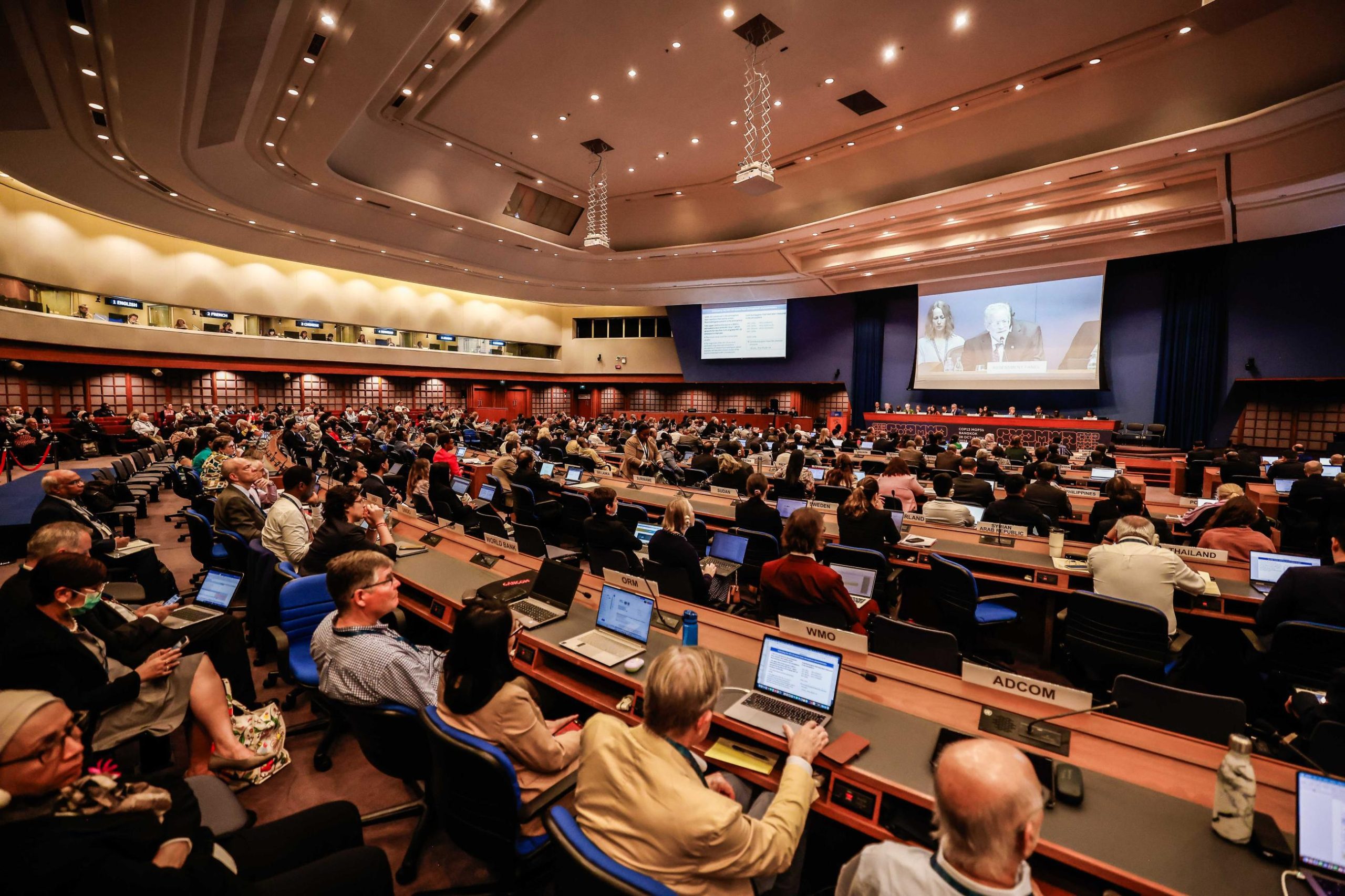
The Montreal Protocol in session (photo by IISD)
The Montreal Protocol has a proven track record of phasing out ozone-depleting substances (ODS), having already achieved a 99 per cent reduction in the production and consumption of the ODS it does control.
Its adaptive, science-led approach, combined with robust financial, technical and scientific support mechanisms, makes it uniquely well-suited to tackling N2O.
Crucially, Parties to the Protocol would not need to address N2O in its entirety nor from all sources in order to have a substantial and positive impact. The Treaty could begin by focussing on industrial byproduct emissions of N2O, which occur during chemical production processes and represent a rapid, cost-effective opportunity for abatement. Addressing these emissions alone could see the Treaty prevent 2.5 billion tonnes of CO2-equivalent emissions by 2050, safeguarding both the climate and the ozone layer.
As a first step, the paper urges Parties to request a special report from the Protocol’s expert Assessment Panels, providing them with the scientific, technical and economic foundation needed to make informed decisions about how best to protect the ozone layer’s recovery while maximising climate co-benefits.
The Montreal Protocol’s ‘start and strengthen’ approach has allowed it to evolve many times before in response to new scientific understanding and technological advancements. Now it is time to do so again. The Protocol offers a proven, pragmatic pathway to address this multifaceted threat, but to seize this opportunity Parties must first arm themselves with the best available science and expertise.
With N2O raised formally under a Montreal Protocol meeting for the first time in July this year, the interest and ambition of some Parties has already been made clear. Our message to the rest of the Montreal Protocol community is clear – ambitious, targeted action on N2O is not just possible, it is essential.
Through the Montreal Protocol, the international community has the tools to tackle N2O. Now, as we approach the 40th anniversary of the treaty in 2027, it is time to use them again.