UK Heat Pump Week: How I decarbonised my home with a natural refrigerant heat pump




To mark UK Heat Pump Week, EIA Climate Campaigner Adam Aucock shares his experience of getting a climate-friendly natural refrigerant heat pump installed in his home.
Within a few months of my recent house move, a major leak in our hot water system left us with some very wet carpets and in need of major works.
Knowing we needed a new heating system and being a climate campaigner, I was keen to have a heat pump installed. However, I also knew that some heat pumps contain highly climate-damaging gases called hydrofluorocarbons (HFCs).
While HFC heat pumps still deliver emissions reductions compared to a gas boiler, I was determined to install a more climate-friendly option.
While the climate-friendly alternatives to HFCs, natural refrigerants such as propane and carbon dioxide, are relatively new in heat pump technologies, they’ve been tried and tested in other heating and cooling technologies for many years.
A natural refrigerant heat pump can reduce the use-life emissions of your home heating system by up to 40 per cent when compared to a HFC system.

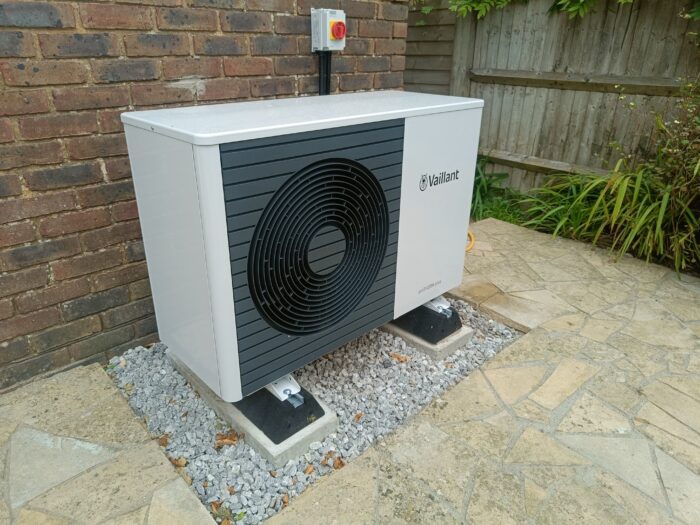
Adam with his newly installed heat pump
The process
We started by contacting several businesses which install heat pumps in my local area. Generally, there are three types of installers to choose from – national energy suppliers who also install heat pumps, a local installer working on their own or a local installer backed by a national assurance scheme.
We had one of each come to the house and provide a quote. We had to pay upfront for some of these quotes, but they were entirely refundable if we decided not to proceed with the works.
With each of these installers, we spoke about my desire to have a natural refrigerant heat pump installed. For some, it was the first time anyone had asked them about the refrigerant, but all of them had an option available and two of them had this as their default option.
After considering all the quotes and picking the one we felt most comfortable with, the installation was booked in. Over five days, my old gas boiler and loft tank were removed the house was prepared for the new system and the heat pump and new water cylinder were installed.
How much did it cost?

The heat pump system’s internal boiler
One of the biggest things we’re told about heat pumps is that they’re prohibitively expensive to install and that they cost more to run than a gas boiler. However, if you get a heat pump through a reputable installer, make use of grant schemes and use a heat pump-specific energy tariff, neither should be true and you should in fact save money.
With the UK Government grant (£7,500) and a cashback offer from our mortgage provider (£2,000, which is offered by several large mortgage providers in the UK) as well as a little bit of DIY work to prepare the house for the heat pump, we were able to have the system installed for only £500 more than a new gas boiler system. There was no increase in price for getting a natural refrigerant system.
As part of our installation, we were given a performance guarantee, which means if our heat pump is less energy efficient than the quoted level, the installer will come back and make upgrades to meet the guarantee.
This means that we know our heat pump will be about four times more efficient than a gas boiler and will therefore use about four times less energy. Unfortunately, due to systemic problems with the UK’s energy pricing system, electricity is also about four times more expensive than gas. This means a heat pump on a regular tariff should be cost neutral in its use phase. However, several providers now offer heat pump-specific tariffs that allow you to significantly lower the unit price you pay for electricity – our tariff gives us electricity at only about twice the price of gas – meaning you can save money compared to running a gas boiler.
As an example, in September, when I was using the heat pump to heat my hot water, the system used 54.6kWh of electricity to generate 233.8kWh of hot water, costing me £8.10.
Brand new gas boilers are roughly 95 per cent efficient (because some energy is lost in the process of turning gas to hot water), so would have required 246.1kWh of gas to produce the same amount of hot water, which would have cost £14 – meaning the heat pump delivered a 40 per cent saving. While £5.90 might not be a significant amount of money, when the heat pump is also heating the house, the difference will be more meaningful.
Laboratory efficiency testing and real-world data also suggest natural refrigerant heat pumps can be 6-7 per cent more efficient than HFC systems, making it easier to make a saving. Read more in EIA’s recent report Pumping up the Potential: Maximising the climate benefits of Europe’s heat pump roll-out with natural refrigerants.
What more could the UK Government be doing?
 The UK Government has pledged to continue the Boiler Upgrade Scheme, which provides £7,500 for heat pump installations in England and Wales (a similar scheme runs in Scotland).
To drive adoption of natural refrigerant heat pumps, which reduce direct emissions and help with energy efficiency, the UK should adopt a similar scheme to that in some European countries. Germany’s heat pump subsidy scheme offers an additional five per cent subsidy for the installation of a natural refrigerant heat pump and since this scheme has been in place the proportion of heat pumps installed using a natural refrigerant has grown to more than two-thirds of all installations.
Secondly, there is a desperate need for a rebalancing of the energy pricing system. The UK has one of the highest electricity-to-gas price ratios in Europe. At the moment, significant levies are placed on electricity that are not equally applied to gas. The UK Government should make efforts to close this price gap by either shifting these levies onto gas sales, into general taxation or a mixture of the two. Lower electricity costs will make the installation of a heat pump an even clearer economic benefit for many households and could help boost other electrification initiatives.
Finally, the UK has fallen behind the EU when it comes to action on HFCs. In 2024, the EU implemented a world-first HFC phase-out, but despite the UK Government promising to consult on an update to its own regulation covering HFCs, it has repeatedly missed its own deadlines.
To make trade easier with the EU, where most of the UK’s air-to-water heat pumps come from, the UK should align with the EU on its stance on HFCs.