Reflections on Paris + 10



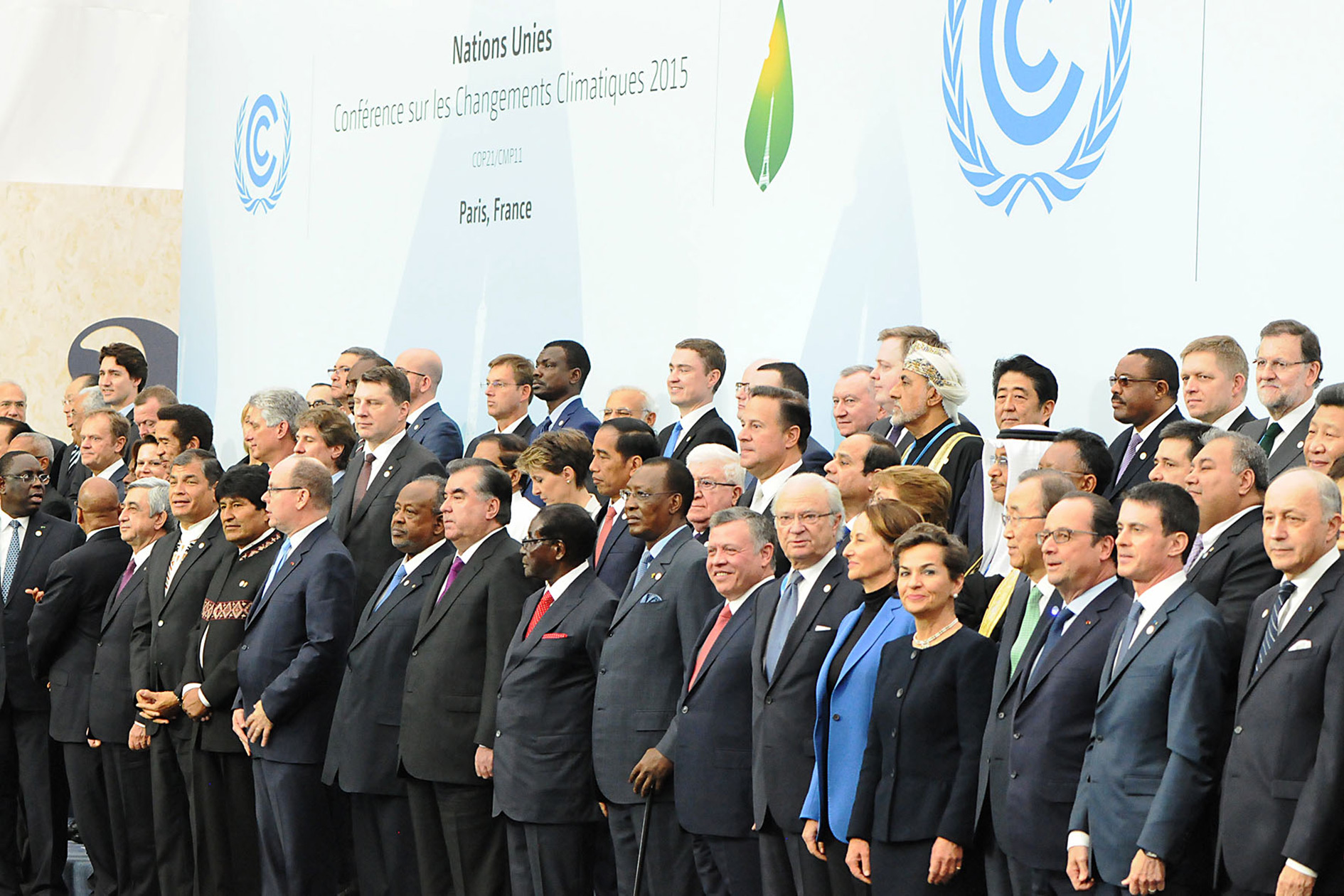
“11-COP21_Foto de familia presidentes” by ConexiónCOP Agencia de noticias, CC BY 2.0
Ten years ago, on 12 December 2015, 195 governments adopted the Paris Agreement at the 21st UN Climate Change Conference (CoP21). A decade on, it is time for both reflection and renewal.
Before the Paris Agreement, the world was predicted to be heading towards something close to 4C of warming this century. Based on current policies, we are now facing an increase of an estimated 2.3°C to 2.5°C by the end of the century. the situation is still critical, and climate change remains the greatest existential threat we have ever faced, it is clear that without the Paris Agreement, emissions would be higher and the gap between where we are and where we need to be even wider.
A key element of the agreement was the adoption of the 1.5°C target, strengthening ambition from the previous 2°C target thanks to strong advocacy from the Alliance of Small Island States (AOSIS) and the Least Developed Countries (LDCs). A subsequent report from the Intergovernmental Panel on Climate Change (IPCC) showed the world the significant impacts resulting from 2°C of warming compared to 1.5°C, further embedding 1.5 as the symbolic global goal and normalising the idea of “net zero”, which is now written into law or policy in many countries and used by companies, investors and cities to formulate their long-term plans.
According to the science, both the 1.5 °C and 2°C targets require “rapid, deep and in most cases immediate greenhouse gas emission reductions.” Despite this, emissions are increasing every year. We are not on track, or anywhere near to reducing emissions sufficiently to remain within the 1.5°C target. And each year the headlines from the UN Climate Change Conference are abjectly depressing. The COPs are inundated with, and sometimes even run by, fossil-fuel advocates. The COP “outcomes” repeatedly fail to even mention fossil fuels, let alone agree the mandatory phase-out that we need.
Given this, the Paris anniversary might feel less like a celebration and more like a tragic symbol of failed multilateralism.
We would argue, though, that the Paris Agreement itself has not failed. What is failing is our ability to deliver.
Essentially the Paris Agreement is a pathway to a common objective. It contains a requirement for countries to submit and update nationally determined contributions (NDCs), and a process for checking progress, via the Global Stocktake. But it does not contain a detailed plan for how to transition away from fossil fuels or reduce other climate super pollutants like methane, hydrofluorocarbons (HFCs) and nitrous oxide (N2O).
Over the past decade, a lot of attention has been placed on what comes out of the COP process. These negotiations matter; they send important signals, create mandates and keep pressure on governments. But they have proven incapable of serving as implementing tools.
The consensus-based nature of the UNFCCC process also presents a significant challenge. The principle of “leaving no country behind” has been increasingly used as “hold all other countries back”, slowing down progress and supporting the priorities and needs of a handful of countries that prefer the status quo.
If we want the next decade to look different, we need to stop asking the Paris Agreement to do something it was never designed to do and start building complementary systems and the financial architecture that can support countries in moving from COP pledges to action. EIA sees this as three major steps.
The first step is to disaggregate the problem. Climate change is not a single issue with just one greenhouse gas. It is a complex bundle of very different challenges: fossil fuel production and use, methane and other super pollutants, industrial gases, cooling, agriculture… Each has its own politics, solutions and financial needs. Trying to resolve all of this in a single negotiating room guarantees that we will keep landing on the lowest common denominator. In contrast, a successful approach is demonstrated by the Montreal Protocol on substances that deplete the ozone layer. It focused on a clearly defined problem, set clear timelines, and was backed by predictable support to help developing countries make the transition. That combination of clear objectives, sustained implementation and support aligned with national plans is at the heart of its success. This should inform how we tackle other parts of the climate challenge: set up dedicated, issue-specific tracks that are designed to match the nature of the problem.
The second step is to work with willing countries. Waiting for unanimous agreement has not delivered at the pace we need. Where we have seen progress, it has often come from coalitions of countries deciding to move faster together and then using that momentum to shift the wider system. The Beyond Oil and Gas Alliance (BOGA) is one example. It brings together national and regional governments committed to the managed phase-out of oil and gas production, creating a community of practice for the transition. Since its launch, BOGA has increased the profile and urgency of transitioning away from fossil fuels, mobilised action and commitments at high-level events and enhanced the institutional, technical and financial support provided to its membership and other first movers. More recently, the announcement of the first International Conference for the Phase-Out of Fossil Fuels by Colombia and the Netherlands in April 2026 signals a similar approach. The conference will provide a strategic space for dialogue among governments and other committed actors to explore concrete pathways for moving away from fossil fuels. The point is not to replace the UN process, but to complement it by moving further and faster than a consensus-based system allows. Other examples include the Global Methane Pledge (GMP) and the UNEP Working Group on Nitrogen, among others.
The third is to fix the architecture around financial and technical assistance. Many governments that want to act are held back by the way support is structured. Climate finance is still too project-based, too fragmented and too hard to navigate. A country facing decisions about fossil fuels, methane, cooling and adaptation at the same time cannot plan a serious transition on the back of a handful of pilot projects. It needs stable, predictable, long-term support that is organised around its own plans and institutions. The Climate and Clean Air Coalition’s Super Pollutant Country Action Accelerator launched at COP30 is an example of what this could look like. Rather than funding standalone methane projects, it is designed to help set up teams within developing-country governments, providing technical assistance where it matters most, allowing countries to develop and implement country programmes on methane and other super pollutants. In other words, it embeds teams in government and pairs institutional strengthening with targeted technical assistance around specific pollutants – not unlike the Montreal Protocol. This kind of architecture is what allows willing countries to actually deliver what they have promised under the Paris Agreement instead of constantly stitching together short-term, one-off initiatives.
To build on this momentum, we need to scale the model. That means increasing the support that the Country Action Accelerator can provide, which can be made possible by pulling available and future funding in one dedicated fund for methane and other super pollutants. A single fund built around the Accelerator’s theory of change would allow more countries to access tailored assistance while ensuring that resources are deployed strategically, without duplication or gaps.
The country programme approach must also be strengthened for the energy transition. Country platforms were created to move beyond isolated projects toward coordinated, country-led transition plans that align public and private finance, but they have yet to be developed or used in a way that delivers a clear, sequenced phase-out of fossil fuels. Making this approach effective means expanding it and consolidating the financial and technical architecture that supports these platforms, including stronger coordination among providers of concessional finance and predictable multi-year transition pathways. Only then will countries have the coherent, long-term support needed to phase out fossil fuels at the speed and scale the next decade demands.
The next decade will be judged on whether we build mechanisms that can operate at pace, survive geopolitical upheavals and deliver real-world change. The Paris Agreement remains necessary, but it is no longer sufficient. It has given us the direction of travel, we now need to pave the way.
(image: “11-COP21_Foto de familia presidentes” by ConexiónCOP Agencia de noticias, CC BY 2.0 )