My first INC – the view from inside the final push for a binding Global Plastics Treaty

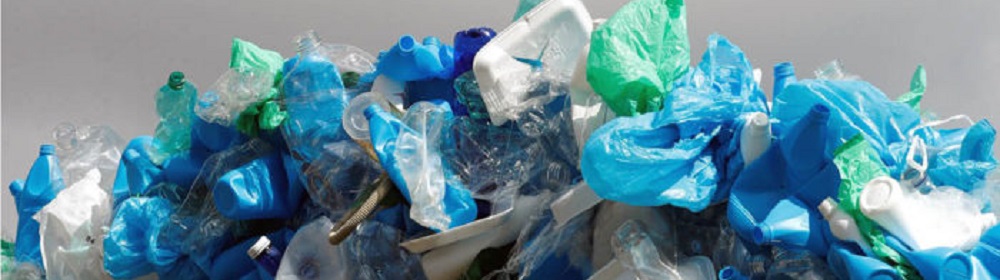
Hannah Hughes is the latest addition to our Ocean Campaign and is getting a proper baptism of fire as she’s plunged into the midst of INC-5.2, what looks to be the final round of talks for a Global Plastics Treaty.
In this special blog, she gives her impression of the first days of the talks taking place in Geneva this week and next …

EIA’s team ready to take part in the Plastic Treaty negotiations, beside Benjamin Von Wong’s art installation The Thinker Burden (c) EIA
On 5 August 2025, I arrived at the impressive Palais des Nations in Geneva, filled with a mix of excitement and nerves.
This wasn’t just another conference; it was my first international negotiation as a representative of the Environmental Investigation Agency (EIA).
Suddenly, the aim to eliminate plastic pollution felt more personal and achievable.
After checking my badge at the registration desk, I took a deep breath and entered the opening plenary. The room was vibrant, with delegates from more than 180 countries, youth leaders, indigenous representatives and technical experts, all gathered with a shared goal – to develop a binding international treaty to combat plastic pollution across its entire lifecycle.
Intergovernmental Negotiating Committee (INC) Chair Luis Vayas Valdivieso immediately set the tone by urging us to craft an “effective, inclusive, implementable” treaty.
From that moment, I shifted from being a passive observer to an active participant. This was not just a rehearsal; it was an historic moment.

Delegates gather for the opening plenary session (c) EIA
Within hours, the negotiations divided into four parallel Contact Groups, each handling a different aspect of the treaty’s complexity.
Contact Group 1 – Products, Chemicals and Production I squeezed into a crowded room where terms such as virgin plastic caps, additives and emission controls were discussed intensively.
The High Ambition Coalition of countries seeking a robust treaty fit to tackle the crisis pushed for reduced production, while delegates from petrostates responded with strategic stalling tactics.
My pen struggled to keep pace with my heartbeat — I could feel the urgency in every word.
Contact Group 2 – Waste, Pollution and Justice Here, the emphasis was on legacy plastic waste and a “just transition” for workers. This wasn’t abstract policy; it concerned real people – waste-pickers in informal economies, indigenous communities safeguarding ancestral lands and workers caught in the turbulence of changing supply chains.
Contact Group 3 – Finance and Implementation This was the crucial part of the treaty. Would there be a dedicated global fund or just another round of non-binding pledges?
I made the point, quietly but firmly, that equity demands resources. Words without funding are merely ink on paper.
Contact Group 4 – Compliance and Governance The debate here was intense – should consensus stay the rule or should majority voting be introduced to prevent a small minority from blocking progress?
The idea of breaking from tradition to accelerate action felt both radical and necessary.
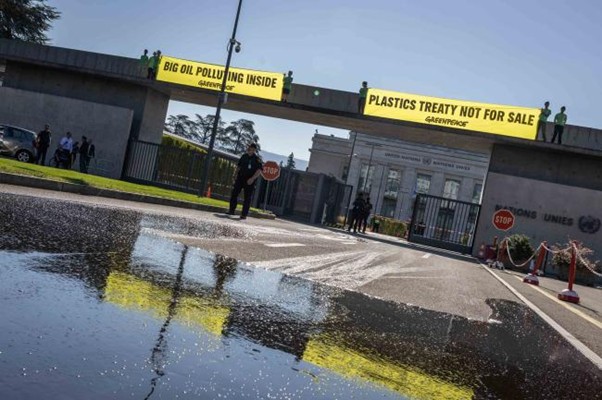
Greenpeace spills fake oil outside the Palais des Nations to emphasise the impact of fossil fuel lobbyists on proceedings (c) EIA
Outside the meeting rooms, the conversations were equally vibrant. Over coffee, I engaged with youth activists, waste-picker union leaders and keen-eyed journalists.
On the third day, Greenpeace activists poured fake oil onto the street outside Palais des Nations to highlight the influence of fossil fuel lobbyists on the negotiations.
As the sun set behind the Palais and the early part of the negotiation drew to a close, I felt both exhilarated and exhausted. My notebook’s highlights read like a brief treaty:
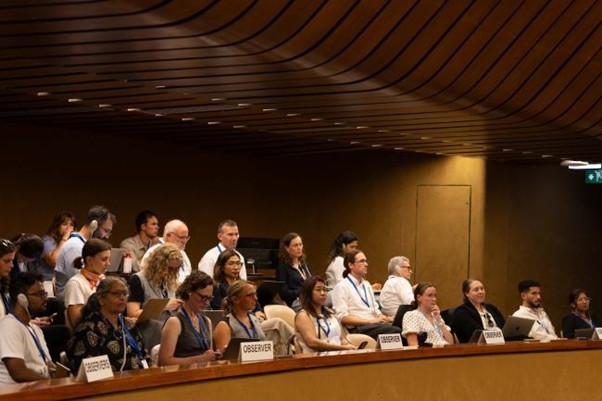
Observers listening intently to negotiations in the Constant Group (c) EIA
That evening, I sat in the Palais gardens, allowing the day’s storm of negotiations to settle in my mind.
The treaty is far from finalised, but what matters is that we are here pushing for ambition, equity and transparency at every turn.
This isn’t just my first INC; it’s my initiation into environmental diplomacy. I’m more determined than ever.
The plastics treaty isn’t just a hope, it’s physically present, included in the text, and making progress through intense debates, contact groups and even in coffee breaks.