An urgent need to reduce emissions – our report on the 37th Meeting of the Parties to the Montreal Protocol


Last week, our Climate team joined more than 600 delegates for the 37th Meeting of the Parties (MoP37) to the Montreal Protocol in Nairobi from 3-7 November 2025.
EIA produced a briefing on the key substantive issues on the busy agenda, outlining the multiple opportunities to maximise greenhouse gas emissions reductions and enhance the recovery of the ozone layer.
All in all, it was a mixed meeting, with current geopolitical challenges to multilateralism quite evident and a disappointing lack of urgency from many governments, despite the fact that we are hurtling past our global climate targets.
However, the countries did manage to negotiate a number of important decisions and set in motion more work on key issues which can be picked up next year when, hopefully, the 10-year anniversary of the Kigali Amendment will inspire governments to take much greater steps to protect our planet. Here are a few initial reflections on the key meeting outcome.
One day before MoP37 began, a day-long informal meeting on implementation of the Montreal Protocol was held, covering a range of areas aimed at strengthening the institutions of the Protocol, including licensing systems, illegal trade, data collection and capacity.
This has been a priority for EIA since our exposure of the illegal production of CFC-11 in China highlighted major gaps in the Protocol’s monitoring, reporting, verification and compliance regime. In advance of the meeting, we produced a stand-alone briefing with recommendations for next steps.
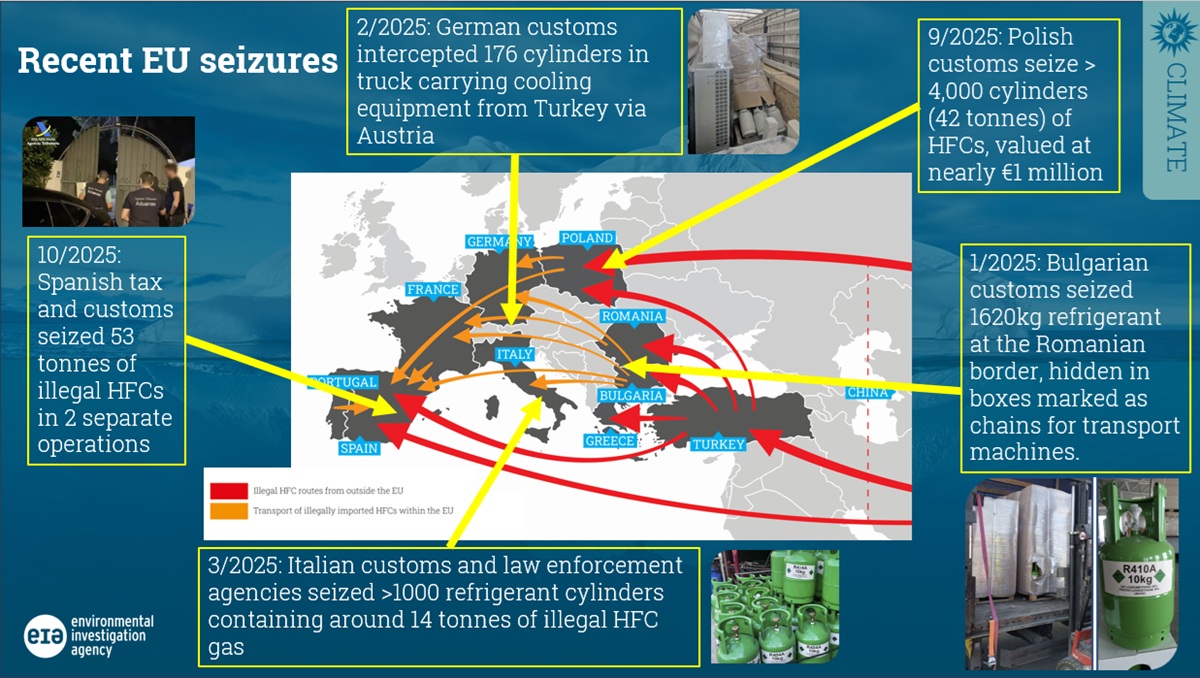
In my role as resource person for the illegal trade break-out groups, I presented information on recent trends, methodologies and solutions to illegal trade to two groups, which then discussed issues such as reporting, available enforcement measures including Standard Operating Procedures for customs, options for dealing with seized goods, the increasing role of e-commerce and the need for improved supply chain tracking and the benefits of banning disposable cylinders. Multiple key take aways from the day were presented (see, for example, Session 8) and summarised in an outcomes document.
During the MoP, the EU proposed a draft decision to strengthen licensing systems, while other delegations noted their desire to expand the discussion to all areas covered by the informal meeting, eg, to discuss issues such as supply chain tracking, disposable cylinders and developing country capacity to address illegal time. With only two short contact groups to discuss the multiple potential next steps, we were not able to make significant progress, although parties agreed to pick up these discussions next year.
While disappointed that there was no formal outcome at this meeting, illegal trade is clearly an important issue for many countries. On Tuesday evening I joined a panel of experts, including OLAF, Europol, BRS Secretariat and Sri Lanka, in a packed side-event co-organised by the Ozone Secretariat, OzonAction and the World Customs Organization, presenting on the latest developments in illegal trade, particularly focusing on our European investigations.

Clare Perry presenting on illegal trade of ODS and HFCs at a UNEP-WCO side event at MoP37
Fundamental to the success of the Montreal Protocol to date is the Multilateral Fund, the dedicated financial mechanism which supports Article 5 parties to implement the controls of the Montreal Protocol.
Next year, parties will negotiate the three-year replenishment of the Fund for 2027-29 and this year the parties negotiated the Terms of Reference (TOR) for a study by the Technology and Economic Assessment Panel (TEAP) on the level of the fund required, which will inform those negotiations.
As usual, Article 5 and non-Article 5 parties started at polar ends of the debate with donor countries wanting to restrict the TOR to compliance needs only (ie, ODS phase-out and HFC phase-down controls that are in the Treaty) while Article 5 countries urged that funding also covers the plethora of non-compliance requirements (eg, such as energy efficiency, reducing emissions from ODS banks and other decisions of the Montreal Protocol).
The US repeatedly noted that the last replenishment had been too high and that the Executive Committee of the MLF was unlikely to approve much more than half of the funds.
Ultimately, the decision struck a balance with the TOR covering all decisions agreed on by the parties, with a compliance-based methodology but with additional information on accelerated HFC phase-down scenarios. A draft report will be produced prior to the 48th Open-ended Working Group (OEWG) in 2026.
Global emissions of HFC-23 remain significantly higher than reported data, raising compliance concerns with the Kigali Amendment.
Although the latest science shows emissions have reduced, there remains a significant emissions gap which cannot be explained by known sources. This issue is very high on the agenda for many governments, given the compliance implications, and it was given more negotiation time in contact groups than any other subject. This resulted in a decision which requests an update from the science and technology panels to the next MoP, including additional analysis of the emissions gap, identification of the data gaps and limitations and information on the way that countries estimate and report HFC-23 emissions.
Alongside this, relevant countries (those with HCFC and HFC production) are requested to examine the issue at national level and encourage scientific collaboration. To understand and address these significant emissions, we need more data and, particularly, more transparency from the global fluorochemical industry.
The African group of countries proposed a decision on national and regional initiatives to support the implementation of the Kigali Amendment.
This came from text previously proposed by Rwanda and the UK, highlighting the utility of regional “centres of excellence” in promoting sustainable cooling and activities that are complementary to those being funded by the MLF.
Although the original idea to hold a workshop to explore this issue further was not agreed, a decision was agreed requesting parties to submit information on centres of excellence and testing centres for energy efficiency, which will be collated and summarised by the Ozone Secretariat for MoP38.
Discussions on filling the gaps in global atmospheric monitoring of substances controlled by the Montreal Protocol have been taking place for several years.
A report from the Ozone Secretariat and the Advisory Committee of the General Trust Fund (GTF) evaluated the suitability of 10 potential sites around the world for setting up new monitoring of regional emissions of controlled substances.
A number of next steps were agreed, including continued evaluation of the potential monitoring sites and consultation with the relevant countries that might be interested in hosting a monitoring station.

Potential new regional monitoring sites identified by the Ozone Secretariat and GTF Advisory Committee
The contact group on feedstocks met four times to discuss a text which had been originally proposed by the EU and Switzerland at the OEWG. The text was strongly opposed by Saudi Arabia and India in particular, raising multiple issues in terms of the objectives and value added of the decision.
Saudi Arabia took issue with the request for regular reporting by the TEAP, claiming that feedstocks were “comprehensively dealt with” via Article 1 para 5 (the definition of production, which excludes feedstocks) and Decision 4/12 (which clarified the exemption for “insignificant quantities of controlled substances”).
Additionally, India refused to agree to a request for parties to share information on emissions from feedstocks, stating that there was no obligation on emissions.
Despite it being repeatedly pointed out that both the SAP and TEAP had drawn attention to the fact that emissions from feedstocks are not insignificant, and the TEAP confirming the work could be done and would produce a “meaningful report”, the countries blocked any acceptance of two out of three of the operative paragraphs of the decision.
Although the EU and Switzerland attempted to salvage a decision based on the remaining paragraph, this was blocked by the US and Australia as they saw no added value in the paragraph since it was contained in a previous decision (XXXVI/5).
For me, this was probably the most frustrating contact group of the meeting. In 2022 the SAP assessed emissions for a range of regulated ODS feedstocks to be as high as 146 million tonnes of CO2 equivalent in 2019. This is more than the combined emissions last year of the 63 lowest-emitting countries in the world.
When emissions from literally just a handful of fluorochemical companies around the world are as high as this, it’s hard to understand why countries such as India insist that there is no obligation to even share information to help understand and mitigate them.
Moreover, the text of the actual Montreal Protocol treaty contradicts India and Saudi Arabia’s position entirely. Article 9: Research, development, public awareness and exchange of information actually requires parties to cooperate in promoting research, development and exchange of information on best technologies for “improving the containment, recovery, recycling, or destruction of controlled substances or otherwise reducing their emissions”.
This decision was originally proposed by Chile, Cuba and the Dominican Republic with a view to requesting TEAP to provide a comprehensive report for MoP39 analysing the global quantities accumulated refrigerant, with a focus on options for unwanted refrigerants which need to be destroyed.
With more than 100 A5 Parties having now drawn up inventories of their unwanted ODS banks, this issue is high on the agenda, with a need to consider both how the collection and disposal of existing banks should be funded and how the accumulation of future banks can be prevented.
The contact group met three times, agreeing decision text which requests the TEAP to prepare a report for the next MoP that includes an estimate of the global level of used and unwanted refrigerants, existing destruction and reclamation sites and an estimate of the potential benefits associated with the reclamation and destruction of used and unwanted refrigerants.
The issue of ODS and HFC banks was a hot topic for discussion in the margins of the meeting too. Several side events focussed on the issue throughout the week, including EIA’s own event on Thursday 5 November, which brought together an engaged audience from civil society, National Ozone Offices and interested parties. During the side-event, independent experts Cecilia Mercado and Duncan Brack presented preliminary findings from our draft report, Sustainable Financing for ODS and HFC Bank Management, inviting those in attendance to provide comments and feedback to include in the final publication.
With the MLF’s funding window for bank inventories closing next month, it is now vital that long-term, sustainable solutions to financing bank management are sought, ending the current reliance on systemically flawed carbon markets.
EIA’s side event, which also highlighted insights and relevant experience from Article 5 and non-Article 5 stakeholders, and our forthcoming report are timely additions to this important conversation.

EIA campaigner Tom Nickson facilitated a side-event at MoP37 on sustainable financing for ODS and HFC bank management
In addition to the decisions negotiated during the meeting, a number of decisions proposed by the Implementation Committee were adopted, including a decision on the Democratic People’s Republic of Korea, which has repeatedly exceeded its HCFC control limits.
For the first time ever, the MoP called for a suspension in trade in HCFCs between the DPRK and other parties, which will continue until the country returns to compliance.
Other decisions dealt with a lack of reporting on data, changes to Kigali baseline data and potential non-compliance by a number of countries with the Kigali Amendment (namely Mali, Saint Vincent and the Grenadines, Tajikistan, Zambia). These parties are urged to submit a plan of action by March 2026 to enable them to return to compliance.
The Montreal Protocol is often referred to as a model example of effective multilateralism and the collective spirit which has allowed it to continually expand and strengthen are still there, as evidenced by the number of decisions negotiated through the week.
However, the progress does not align with the urgent need to reduce emissions of ODS and HFC super pollutants and much remains to be done.
The meeting finally finished its work shortly after midnight on Saturday 8 November due to a disagreement between members of the Eastern European States (EES) regional group over their nomination for the Implementation Committee.
Since the countries involved could not come to a decision, it was agreed that an extraordinary MoP will take place during OEWG48 in 2026 to finalise membership before the next meeting of the Implementation Committee.
Next year, the OEWG48 will take place from 13-17 July and the Meeting of the Parties will be in Kigali, Rwanda, from 2-6 November – a fitting venue for the tenth anniversary of the Kigali Amendment, which was agreed there on 15 October 2016 at the 28th MoP.
Finally, I’d would like to pay tribute to European Commission delegate Cornelius Rhein, who sadly passed away just prior to the meeting. Cornelius was a treasured member of the ozone family for many years, contributing to and starting so many important initiatives, not least the atmospheric monitoring and other strengthening institutions work which was the focus of the informal meeting.
He was a lovely, kind man and our thoughts were with him throughout the week.

EIA with other civil society partners and the Executive Secretary of the Ozone Secretariat, Meg Seki