
DONATE

Climate reports

Implementation of the Methane Abatement Partnership Roadmap

The Methane Abatement Partnership (MAP) Roadmap, launched at COP29, outlines actions for importer-exporter cooperation to cut methane emissions in fossil energy supply chains through transparency, monitoring, and investment, supporting a rapid transition away from fossil fuels.

Briefing to the Informal Meeting on Facilitating Implementation of the Montreal Protocol

Following revelations of unexpected CFC-11 emissions in 2018 and reports of record atmospheric HFC-23 concentrations and other unexpected emissions, legitimate questions have been raised as to whether the Montreal Protocol’s institutions and controls are fit for purpose, not only to sustain the phase-out of ozone depleting substances (ODS) but also to address the unique challenges of the hydrofluorocarbons (HFC) phase-down.

Thought Starter on the Implementation of Paragraph 28(d) of the First Global Stocktake

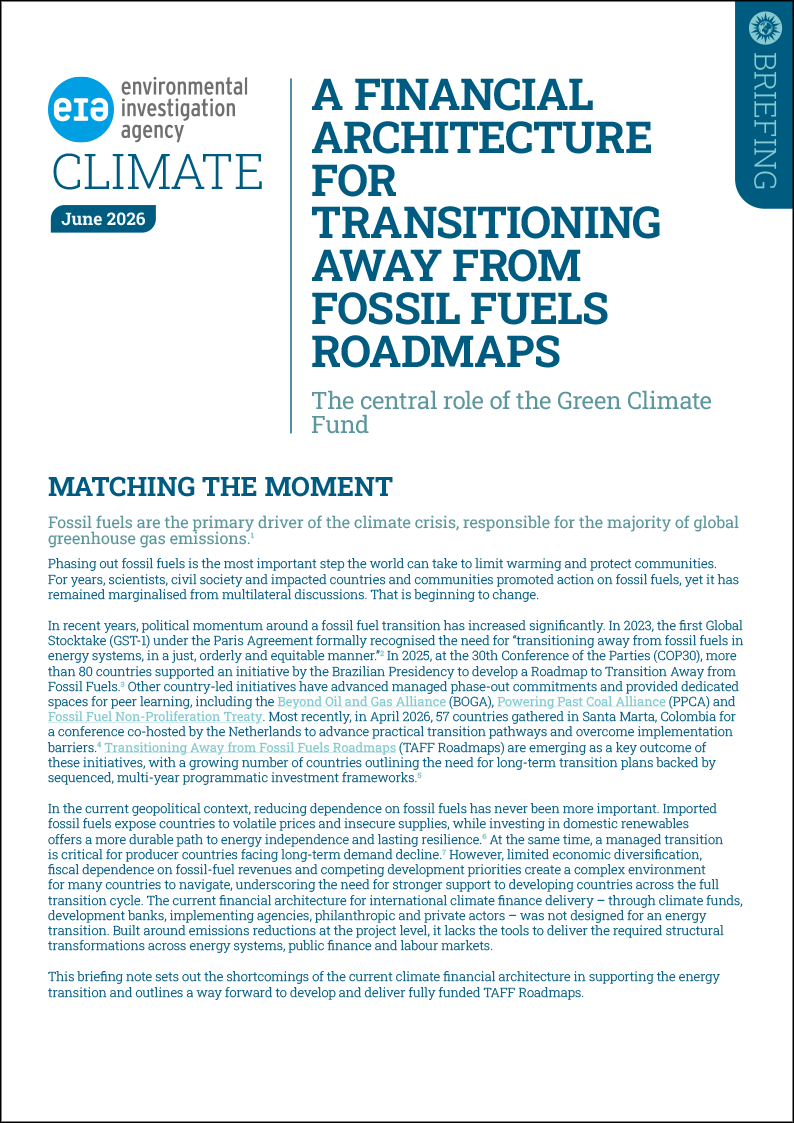
This briefing identifies the three mutually reinforcing pillars of action to operationalise Paragraph 28(d) of GST-1: (i) monitoring and reporting; (ii) national action; and (iii) financial and technical assistance. Unlike the predominant approach to climate mitigation, which tend to be emissions-based, implementation of paragraph 28(d) of the GST-1 should focus on transitioning the sources of energy, from fossil fuels to renewables, across the economy through planning and investment.

Persistent Problems

EIA urges all governments and parties to the Montreal Protocol to apply the precautionary principle, wherever possible avoiding the uptake of HFOs to avoid unnecessary risks to people and the planet. Governments, parties to the Montreal Protocol and manufacturers and commercial users of these products must act to implement a transition away from all F-gases.