

Climate Super Pollutants
If the UK intends to uphold its commitment to achieve net zero emissions by 2050 and demonstrate climate leadership, fast action on climate super-pollutants must be prioritised.
- Areas of work:
- Campaigns:
If the UK intends to uphold its commitment to achieve net zero emissions by 2050 and demonstrate climate leadership, fast action on climate super-pollutants must be prioritised.
The legacy of the Montreal Protocol is one of delivering above and beyond its initial remit. UN Secretary-General António Guterres has described the Montreal Protocol as a “powerful symbol of hope”, calling on Parties to now go further. At MoP36, EIA calls on all Parties to embody the spirit of the Montreal Protocol once again and to demonstrate it truly is the world’s most successful environmental treaty.
The Montreal Protocol on Substances that Deplete the Ozone Layer has a uniquely successful legacy. For almost four decades, the treaty has been instrumental in protecting the ozone layer and combating climate change, securing the successive phaseout of more than 99 per cent of the production of controlled ozone-depleting substances (ODS).
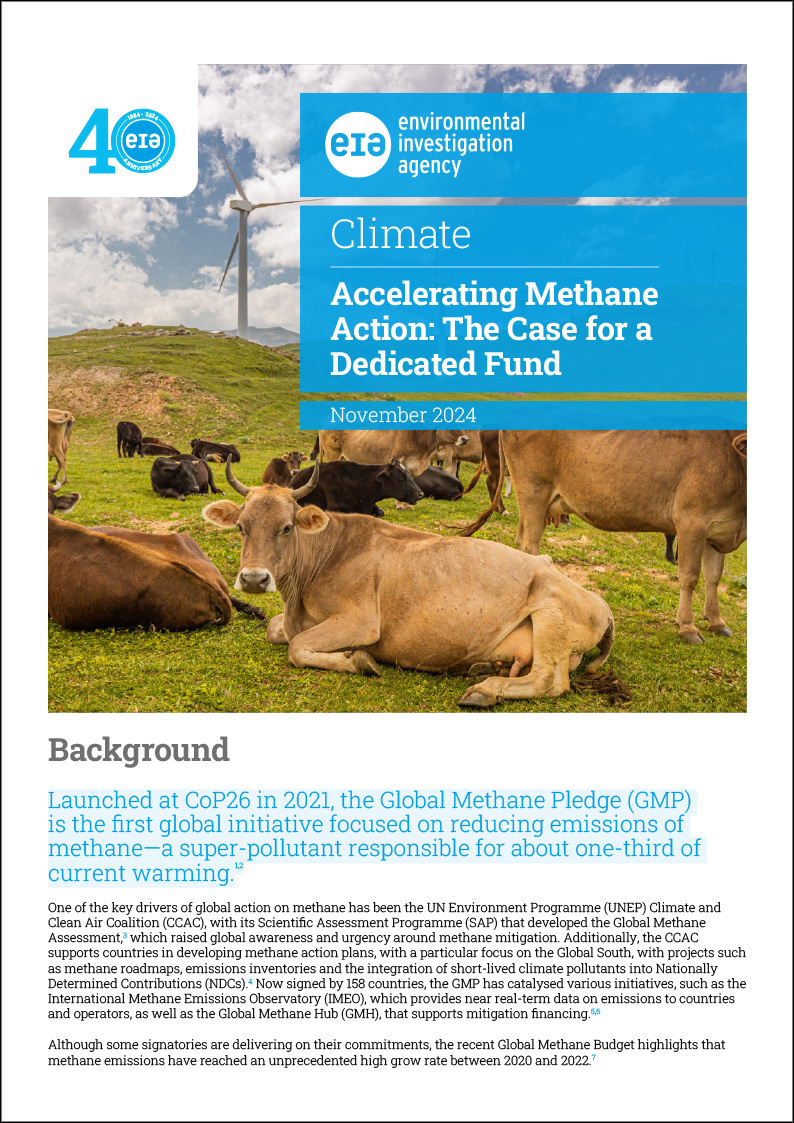
Methane is the second most important greenhouse gas (GHG), around 80 times more powerful than carbon-dioxide (CO2) over a 20-year period, and is responsible for a third of the global warming experienced to date. More than half of global methane emissions are anthropogenic, produced primarily by the agriculture sector (animal husbandry, land use), the waste sector (landfills and wastewater) and the energy sector (extraction and transport of fossil fuels).
What is methane and why care? Methane is a potent greenhouse gas (GHG) with significant environmental and health impacts. It warms the planet around 30 times more than Carbon Dioxide over a 100 year period and over 80 times more over a 20 year period.
Nitrous oxide (N2O) is the most significant ozone-depleting substance (ODS) in the world today and is projected to remain so throughout the 21st century. It is also the third most important greenhouse gas (GHG), being 273 times more potent than carbon dioxide (CO2) on a tonne-for-tonne basis over a 100-year period.