Vietnam makes progress in fight against wildlife crime but still remains a pivotal regional hub

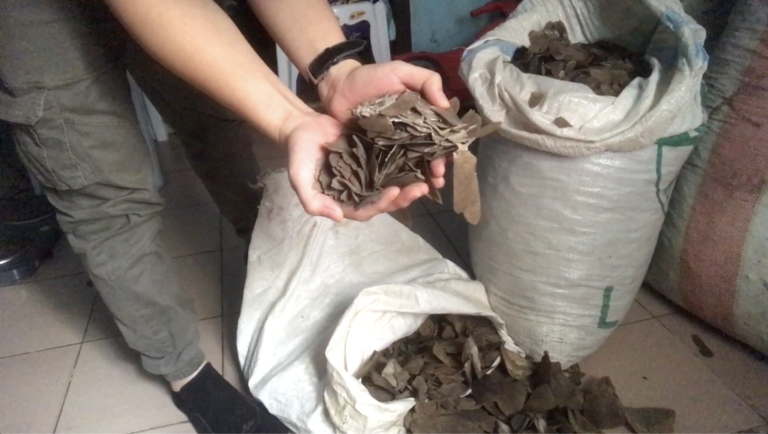
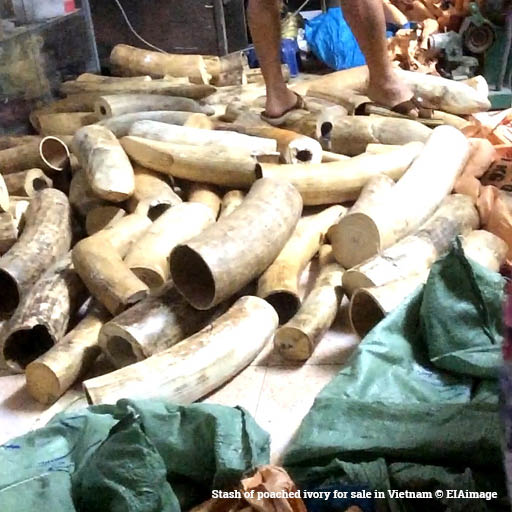
Despite taking some commendable steps to tackle illegal wildlife trade, Vietnam remains a regional hub for criminal networks smuggling products such as ivory, pangolin scales and rhino horns from Africa.
EIA’s research and investigations first exposed the scale of the criminal trade linked to Vietnam in the 2018 report Exposing the Hydra, followed by the 2021 report Vietnam’s Footprint in Africa.
Now, follow-up research and a 2024 investigation on the ground in Vietnam to assess progress conclude that, although the country has made significant inroads in combating wildlife crime, key challenges remain.
 A new report published today, A Pivotal Player – Vietnam’s ongoing fight against the illegal wildlife trade, provides an updated look at elephant ivory, pangolin scale and rhino horn trafficking implicating Vietnam between 2022-24.
The new report draws on seizure data recorded by EIA’s Global Environmental Crime Tracker, open-source research and public reports as well as findings from EIA’s recent investigation.
It also exposes how traffickers move illegal wildlife products across Vietnam’s northern borders and into China and highlights the smugglers’ preferences for specific routes, concealment methods and payment arrangements.
A Pivotal Player also showcases how airlines continue to be taken advantage of by wildlife traffickers. For example, Qatar Airways, which was recently named “World’s Best Airline” and is a founding member and official airline for the Royal Foundation’s United for Wildlife Transport Taskforce, has been exploited by wildlife traffickers. Between March 2020 and November 2024, the carrier was used in at least six incidents to smuggle rhino horns and worked ivory to Asia, including Vietnam, mostly from Angola.
EIA UK Senior Wildlife Campaigner Linh Nguyen said: “EIA congratulates Vietnam for enhancing its responses to illegal wildlife trade in the past three years. However, our new report shows that the country continues to be exploited by traffickers as a primary hub for illegal wildlife products smuggled from Africa and also as a conduit for onward shipment into China. Vietnam must not lower its guard.”
Key findings in the report include:
EIA US Senior Wildlife Policy Analyst Taylor Tench concluded: “In addition to Vietnam’s recent recognisable progress to tackle illegal wildlife trade, the country needs to step up its law enforcement responses, including conducting intelligence and financial investigations.
“Countries implicated in illegal wildlife trade to and from Vietnam need to also increase information exchange to disrupt and deter the criminals. Vietnam cannot solve this problem alone.