UK Gov’t must adopt a national cooling action plan to protect health and climate



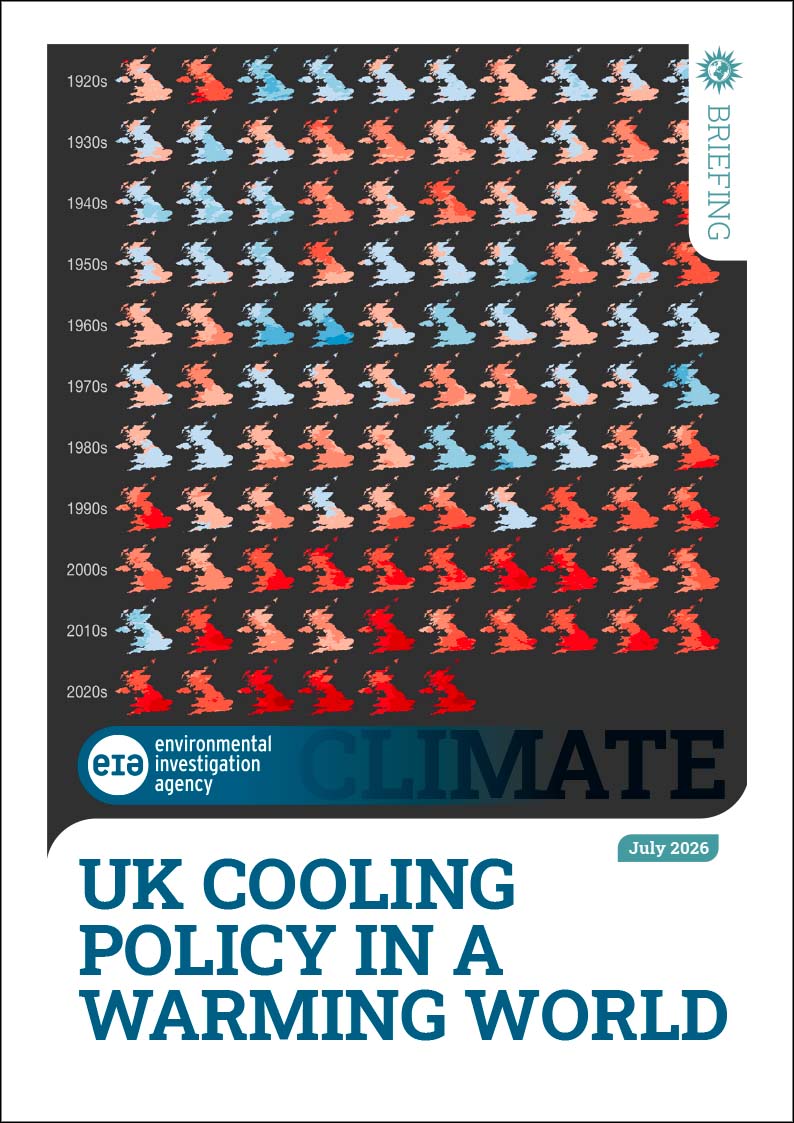
As the UK recovers from its latest record-breaking heatwave, our Climate team today published UK Cooling Policy in a Warming World, an urgent call to action for the UK Government to adopt a national cooling action plan addressing both climate adaptation and mitigation.
With the UK warming faster than the global average, heatwaves are becoming more frequent and intense, leading to thousands of excess deaths annually and widespread overheating in homes, workplaces and public buildings.
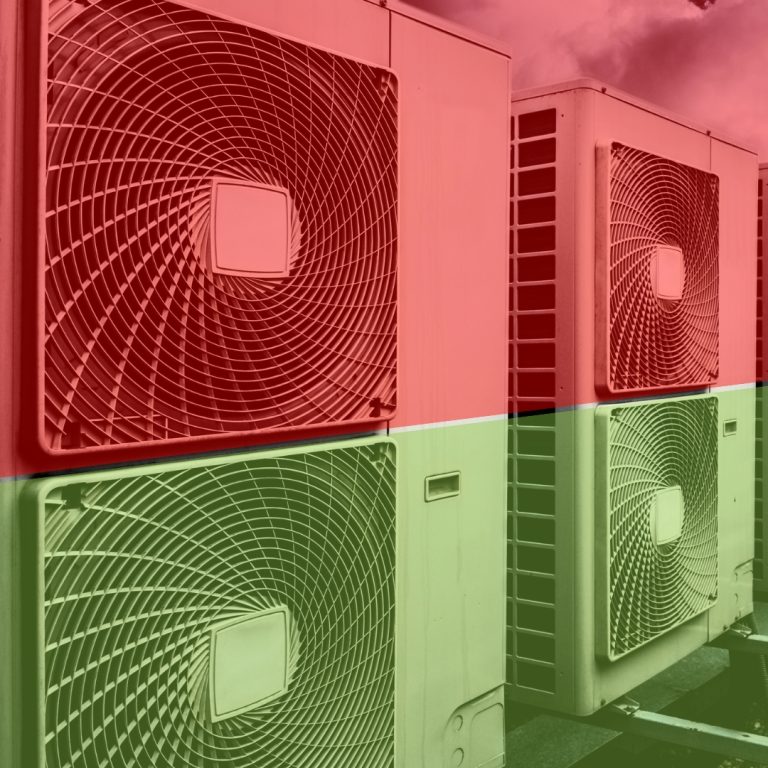
Without strategic intervention, the UK risks a wholesale reliance on air-conditioning, which would drive up energy demand, greenhouse gas emissions and social inequalities.
 EIA is calling for a comprehensive strategy which protects vulnerable people from extreme heat by prioritising passive cooling, urban greening and other solutions to achieve equitable access to cooling.
The new briefing warns that a rapid, unplanned expansion of air-conditioning will result in summer cooling poverty, akin to the winter’s fuel poverty, with urban areas suffering even greater temperature hikes due to the Urban Heat Island effect being significantly exacerbated by air-conditioning.
The heatwave has already triggered a surge in air conditioner sales, with retailers reporting record demand. The recently released fourth independent assessment of climate change risk, A Well-Adapted UK, by the Government’s Climate Change Committee (CCC) encourages more active cooling but fails to mention that most air conditioners run on hydrofluorocarbons (HFCs), a class of synthetic climate super pollutants the UK is trying to reduce under the F-gas Regulation.
In fact, the Seventh Carbon Budget of the CCC, adopted by Parliament last week, requires HFCs and other F-gas emissions to fall by 73 per cent by 2040 – yet current policies are not on track and the revision of the F-gas Regulation has been delayed by Defra.
EIA Climate Campaign Leader Clare Perry said: “The UK is sleepwalking into a cooling crisis. Every new air conditioning unit sold today risks locking in decades of F-gas emissions while doing little to address the root cause of overheating.
“The Government must act now to ban HFCs and hydrofluoroolefins (HFOs) in cooling equipment, mandate natural refrigerants where active cooling is necessary and prioritise passive cooling.
“Natural refrigerants such as CO₂, propane and ammonia are ready, scalable and climate-safe. The EU’s rapid shift to propane heat pumps – now 38 per cent of the market – proves it can be done. The UK must follow suit or risk falling further behind.”
UK Cooling Policy in a Warming World highlights that the UK has a unique window to align its cooling policy to address both adaptation and mitigation. The Government has promised it will publish a “cooling outlook document”, but this is described as a “framework for bringing together existing relevant policies” and appears to fall short of its commitment under the Global Cooling Pledge to publish a national cooling action plan.

Scorched grass in Greenwich Park, London, during a heatwave in August 2022.
Perry added: “National Adaptation Programmes have failed to incentivise the systemic changes need to make the UK safe from deadly heat. A whole-of-Government approach to cooling is needed, one that protects the vulnerable and avoids widening the cooling poverty gap while simultaneously accelerating mitigation.
EIA is urging the UK Government to publish a comprehensive National Cooling Action Plan which aligns adaptation, net-zero and public health objectives. The plan must prioritise: