EU highlights progress on F-gas rules as Europe faces growing cooling challenge


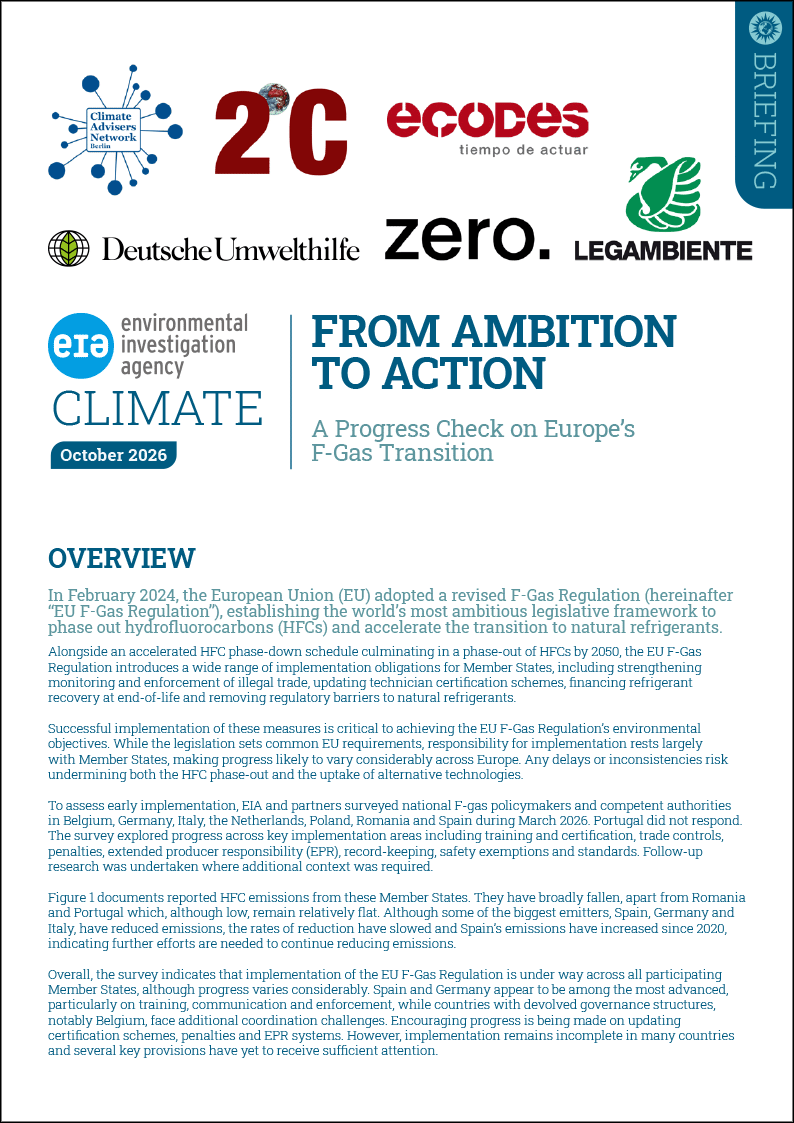
The European Union has an opportunity to demonstrate that ambitious climate legislation can deliver practical results with member states making progress in implementing the EU’s landmark F-Gas Regulation, according to a new report published today by EIA and our partners.
The report, From Ambition to Action: A Progress Check on Europe’s F-Gas Transition, examines implementation across seven EU member states – Belgium, Germany, Italy, the Netherlands, Poland, Romania and Spain and identifies examples of national good practice which could help accelerate progress across Europe, alongside gaps that need to be addressed to ensure the regulation achieves its full potential.
 Adopted in 2024, the revised EU F-Gas Regulation establishes the world’s most ambitious framework for phasing out hydrofluorocarbons (HFCs), powerful greenhouse gases widely used in refrigeration and air-conditioning, and accelerating the transition to natural refrigerants with much lower climate impacts.
With pressure mounting on Europe’s climate commitments, the effective implementation of existing legislation is increasingly important. Our findings show that member states are taking steps to put the regulation into practice, but that greater coordination and cooperation will be needed to ensure progress is consistent across the EU.
This is particularly important as Europe invests in climate resilience and adaptation as expanding access to cooling must not create new dependence on F-gases and undermine progress under the regulation.
The report highlights several examples of action which could be replicated more widely.
These initiatives demonstrate the value of national leadership and provide practical lessons for other member states as they implement the new requirements.
The review also identifies areas where further action is needed.

Seizure of illegal HFCs in Poland
Illegal trade in F-gases remains a threat to the EU’s climate objectives and to businesses complying with the law. While member states are making use of existing customs controls, the report finds scope to strengthen risk-based inspections, improve the tracking of F-gas movements and establish more consistent approaches to enforcement. The European Commission could support this work through common customs risk criteria and further guidance, while member states should ensure that unlawful trade attracts effective and dissuasive penalties.
Technical standards are another important priority. The report finds that responsibility for F-gas policy and product safety standards often sits in different government departments, with limited coordination. Greater engagement by national authorities in European and international standards development is needed to ensure that safety requirements keep pace with technological advances and do not create unnecessary barriers to the safe deployment of natural refrigerants.
Progress on technician certification, refrigerant recovery and monitoring of equipment safety exemptions also remains uneven. Sharing effective national approaches and providing targeted implementation support could help countries address these challenges without weakening the regulation’s common objectives.
EIA Climate Campaign Lead (Illegal Trade) Fionnuala Walravens said: “Europe has set a clear direction for the transition away from climate-damaging F-gases. As the bloc responds to rising temperatures, it must also ensure that investment in cooling supports its climate goals. Our research shows that member states are already developing practical solutions to make that transition work, from training technicians in natural refrigerants to improving customs controls and financing refrigerant recovery.
“The next step is to build on these examples and make them work across Europe. Stronger action against illegal trade, better coordination on technical standards and funding for F-gas-free cooling will help ensure that people and businesses can adapt to extreme heat without locking in further F-gas emissions.
“Europe does not need to reinvent the wheel or lower its ambitions. It needs to learn from what is already working and give member states the support and tools to deliver on the commitments they have made.”