New House of Lords report urges UK Government action on nitrogen within the next two years


EIA is pleased to welcome the new UK House of Lords report Nitrogen: Time to Reduce, Recycle, Reuse (published 24 July 2025).
This timely and thorough examination by the House of Lords Environment and Climate Change Committee brings long-overdue attention to the pervasive and multi-dimensional threat of nitrogen pollution and makes the case for a crucial change in policy, recommending that the Government should develop a comprehensive National Nitrogen Strategy within two years.
We strongly support this recommendation and echo the Committee’s conclusion that such a strategy should be grounded in a UK Nitrogen Balance Sheet to quantify, track and analyse nitrogen flows across the economy and environment.
Developing a National Nitrogen Strategy – something EIA and our partners in the Sustainable Nitrogen Alliance called for in evidence submitted to the Committee – would allow the UK to integrate its targets for climate and ozone protection with its goals for improving air quality, water quality and nature recovery.
By defining such a strategy, and identifying clear priority actions for each sector, the Government can improve cooperation between departments, sweeping away the current “voluntary and piecemeal approach” which the Committee found to be “insufficient to achieve environmental targets”.
A critical component of any effective National Nitrogen Strategy must be the urgent reduction of nitrous oxide (N2O) emissions. Often overlooked, N2O is a uniquely dangerous pollutant, a greenhouse gas almost 300 times more potent than carbon dioxide and the most significant ozone-depleting substance in the world today.
Despite its major climate and public health impacts, N2O remains poorly addressed in current UK policy. In 2022, the UK emitted approximately 18.5 million tonnes CO2-equivalent of N2O, with agriculture accounting for roughly 70 per cent of this total, driven by the overuse of synthetic nitrogen fertilisers.
Compounding the problem, N2O lingers in the atmosphere for approximately 115 years, which means that today’s emissions will continue to heat the planet and deplete the ozone layer well into the next century, as highlighted in EIA’s submission to the House of Lords Nitrogen Inquiry.
The Climate Change Committee’s Seventh Carbon Budget recommends that the UK reduces N2O emissions by at least 53 per cent by 2050 (relative to 2008 levels). This scale of reduction is impossible without immediate, concerted action – particularly in agriculture, which remains the largest and least-regulated source.
Failure to act will come at significant cost. If N2O emissions continue to accelerate, as currently projected, they will render the 1.5°C climate goal unachievable. In addition, the damage these emissions do to the ozone layer could result in the lowest levels of stratospheric ozone seen this century, increasing rates of skin cancer and eye cataracts globally, including here in the UK.
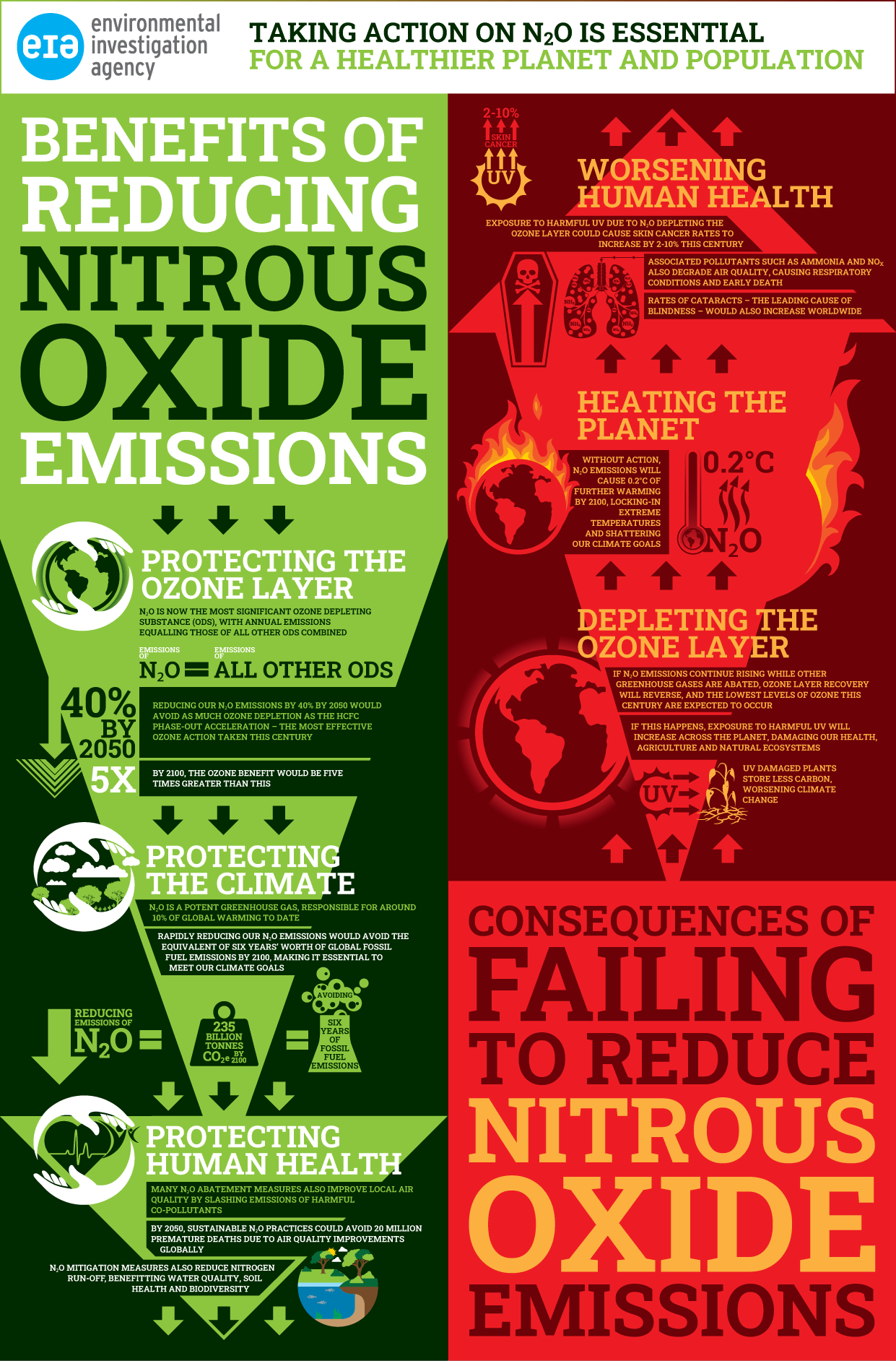
The House of Lords Nitrogen Report acknowledges the importance of tackling N2O, identifying it as a key climate pollutant and calling for a more strategic approach.
To that end, we urge the Government to prioritise the following measures (discussed in detail in our written evidence to the Committee):
Strengthen agricultural policy
As the source of 70 per cent of the UK’s N2O emissions, agriculture must be at the heart of N2O mitigation under any National Nitrogen Strategy.
Modernise wastewater systems
The wastewater sector contributes a significant share of N2O emissions in the UK. Investment and modernisation could go a long way to reducing these, while also providing wider water quality benefits.
Anticipate and regulate emerging sources
The UK must ensure it does not inadvertently drive up N2O emissions through wider decarbonisation efforts, including the use of ammonia as a fuel and the production of bioenergy crops.
Lead from the front on the global stage
The UK has previously shown that N2O mitigation is possible, for example, through its effective regulation of industrial nitric acid production. But as global N2O emissions continue to rise, international cooperation is increasingly essential.
As co-chair of the Climate and Clean Air Coalition (CCAC), and a longstanding leader within the Montreal Protocol, the UK is well-placed to drive progress on the global stage.

The House of Lords Nitrogen Report offers a compelling blueprint for a more coherent, ambitious and science-led approach to nitrogen management in the UK – now it’s up to the Government to deliver.
EIA will continue to advocate for a strategy which puts N2O mitigation at its core and treats nitrogen not as an inconvenient by-product, but as a critical intersection between climate, health and environmental policy.
The time for piecemeal action is over. With strong leadership, strategic planning and the will to act, the UK can take decisive steps to cut N2O emissions and, in so doing, make real progress toward a safer, healthier and more sustainable future.