Can the EU Circular Economy Mini Package address resource, recycling and circularity problems?

Would you feel comfortable feeding your family with food wrapped in plastic made from uncontrolled waste streams?
Do we really want children’s toys or baby bottles made from recycled plastic whose chemical history cannot be reliably traced and so might contain ‘forever chemicals’ and other hazardous additives?
These are not abstract questions. In the coming weeks, the EU will decide when plastic waste stops being waste and starts being a product. That decision could either strengthen Europe’s circular economy or open dangerous loopholes in waste trade controls, with significant consequences for human health and environmental protection.
Together with partners within the Rethink Plastic alliance, EIA has released a briefing setting out key principles and safeguards needed for effective end-of-waste policy.
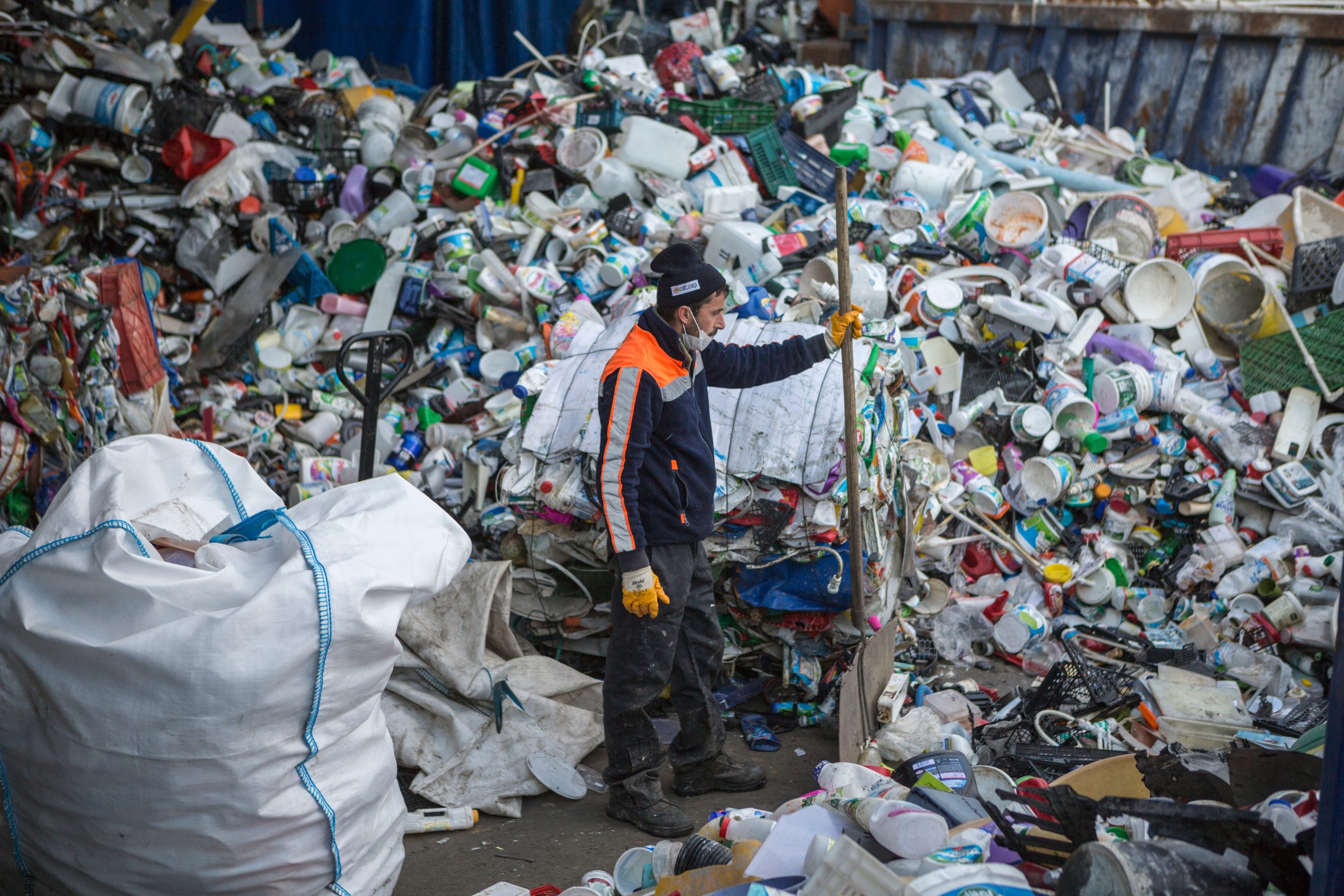
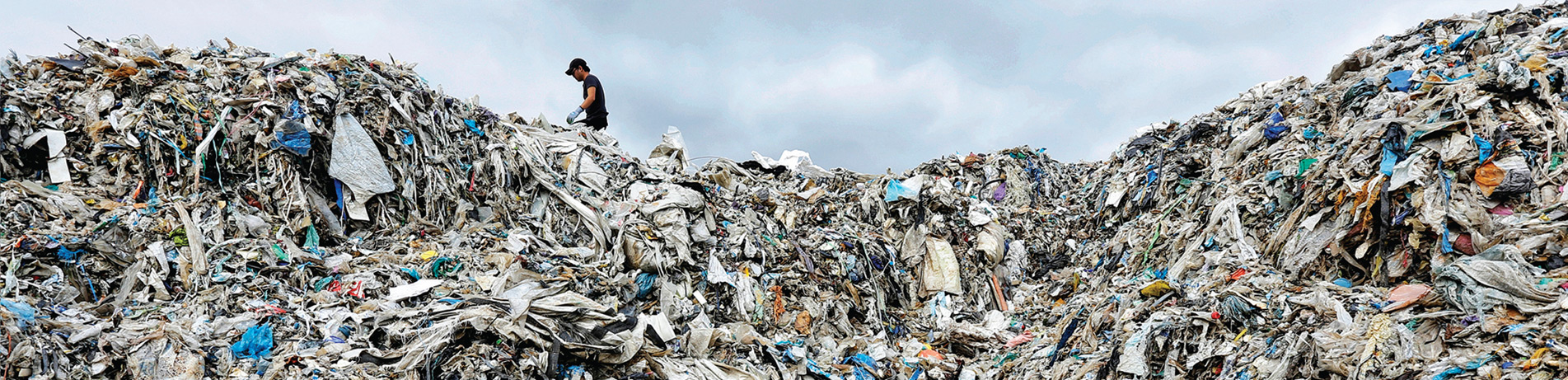
Plastic waste being sorted in Istanbul, Türkiye
The EU’s material footprint remains unsustainably high, while EU circularity rates have increased only slightly over the past decade.
Moreover, the EU consumes too many resources and is largely dependent on imported fossil fuels and raw materials for its domestic production at the same time as the recycling industry is contracting.
This is leading to major waste generation – most of which ends up incinerated, landfilled or exported – and wide-ranging pollution.
To boost circularity, at the end of December the European Commission launched a “Mini Circular Economy Package” to advance EU plastic recycling and the uptake of EU recycled content. As part of this package, the Commission has proposed EU-wide end-of-waste (EoW) criteria for plastics. EoW criteria define the conditions under which a waste ceases to be considered waste after a recycling process and the recycled material can be considered a product again.
To achieve its objectives, the EU must define EoW criteria in a way that ensures safety, sustainability and enforceability. Weak EoW criteria, on the contrary, risk creating additional loopholes that could allow hazardous chemicals and plastics to be embedded and recirculated in new products and inadvertently facilitate illegal trade, undermining long-term circularity as well as human health and environmental protection.
Under EU law, waste and products are regulated very differently. Waste is tightly controlled, especially when it is traded across borders, and products are not. EoW criteria decide when a recycled output crosses that legal line and becomes a product. That means that a recycled waste granted EoW status (and so considered a product again) can be traded in the EU and to non-EU countries in ways that recycled waste not granted EoW status (and so remaining considered as waste) cannot.
Not all recycled waste is granted EoW and becomes products again; this distinction is at the core of why defining a set of robust criteria matters. Recycled outputs not granted EoW status (for example, because of contamination with hazardous chemicals) will mostly still be used in new applications, but they will remain considered waste and subject to waste and waste trade legislation.
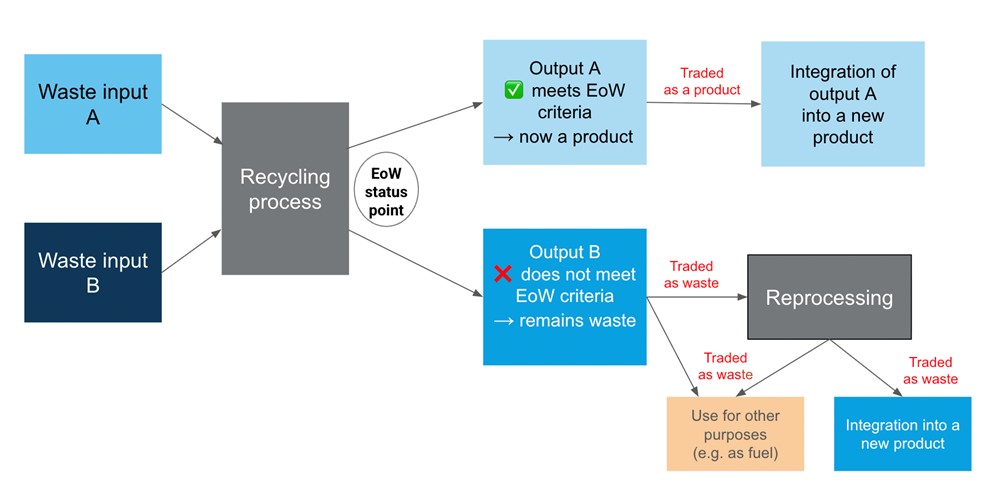
It is therefore essential that EoW criteria are clearly defined, ensure uncontaminated inputs and safe outputs and are accompanied by traceability along the value chain and trade to effectively support toxic-free circularity and trust in recycled materials.
Plastic waste is a highly traded commodity with well-documented impacts on human health, the environment and waste management infrastructure in recipient countries.
Even where plastic waste is declared as “exported for recycling”, substantial volumes are mismanaged, ending up in unregulated landfills or dumped in the environment, or are burnt or processed in unsafe conditions.
Where recycling does occur, imported waste can displace domestic recycling capacity, crowding out locally generated waste and entrenching dependence on low-value, low-margin recycling markets. These treatments pollute air, water and soil while exposing plastic waste workers and nearby communities to toxic fumes and hazardous chemicals.
To end those harmful neocolonial practices, EIA and its allies contributed to securing a default ban on EU waste exports to non-OECD countries – effective from late 2026 – as part of the recent revision of the EU Waste Shipment Regulation (WSR), as well as to increase international controls on most plastic waste.
If end-of-waste criteria are too weak, they risk undoing these protections by allowing waste to be reclassified as a product and shipped with far fewer controls, with no oversight of how it is ultimately treated or what products it could be used for.
Facilitating the trade of recycled materials in the name of circularity should not undermine regulation on harmful waste trade practices nor inadvertently increase illegal trade with the risk that certain operators will exploit EoW policy to misdeclare waste as a product.
EoW and waste trade policies must therefore work hand-in-hand to prevent loopholes, support genuine circularity and ensure a high level of protection.
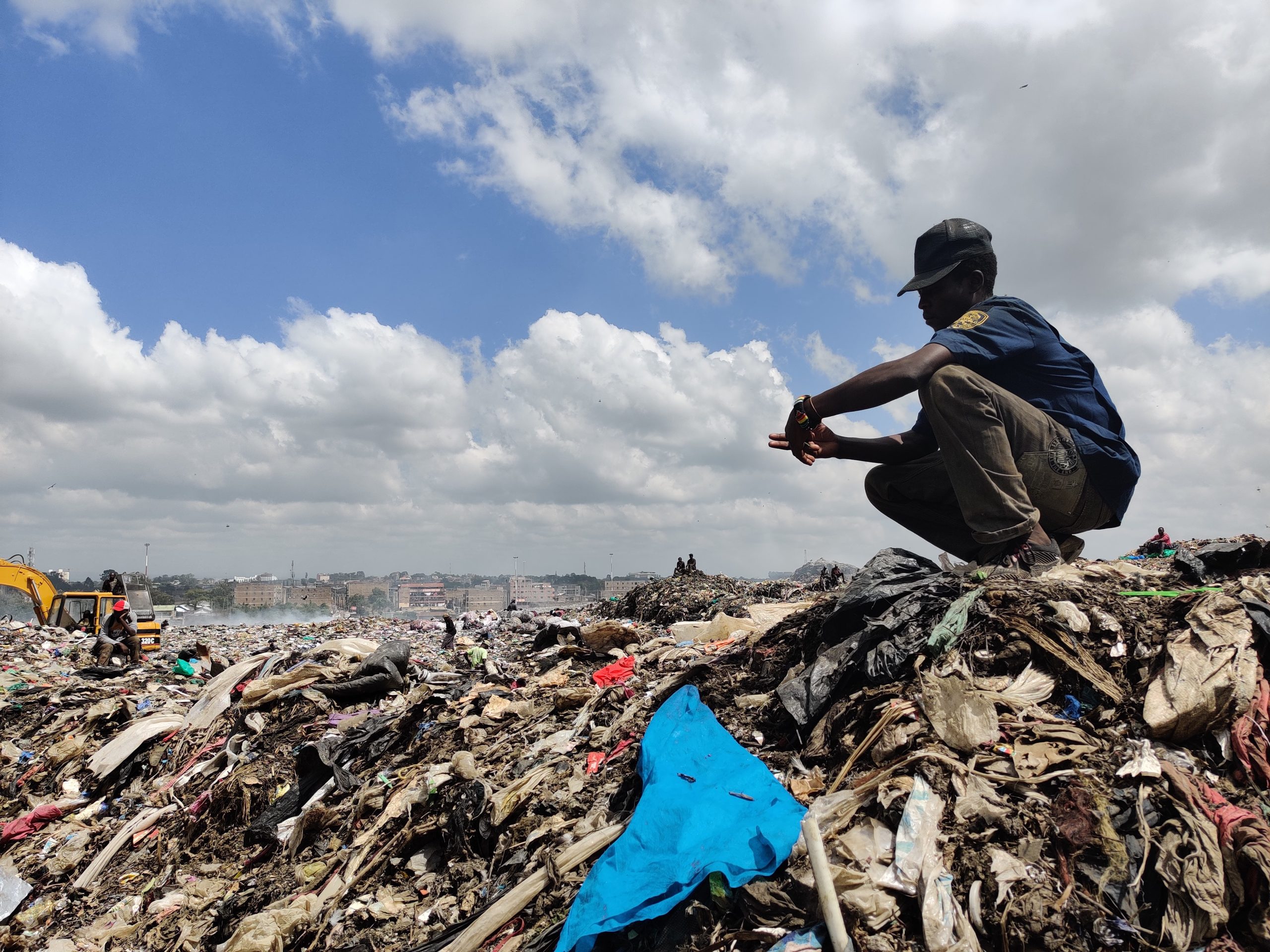
Dandora refuse tip, Kenya (c) EIA
EIA recommends that:
EIA also recommends integrating EoW policy into a wider EU sustainability and safety policy framework as EoW criteria are only one tool within the policy toolbox to support a toxic-free circular economy.
EoW policy should be complemented with measures to reduce waste and detoxify products, including bans on single-use plastics, restrictions on hazardous chemicals and redesigning products and systems for reuse. Such measures can reduce pressure on resources and bring down carbon and microplastic emissions while supporting the EU’s economy and reducing its imports of (virgin and recycled) feedstock.
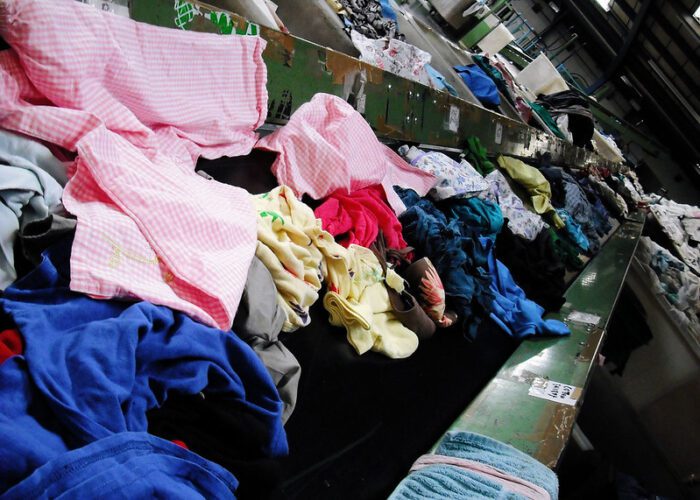
Textile waste in the UK
Textile waste is one of the fastest growing waste streams in Europe, yet it remains poorly controlled.
Large volumes of damaged, soiled and unsellable textiles continue to be exported under the label of “reuse” or as a secondhand product, even when the materials are no longer wearable. In many recipient countries, these shipments quickly become waste and contribute to overwhelming local waste systems and plastic and microplastic pollution.
EoW criteria must not legitimise this reality. For textiles, the default position should be that materials are waste unless and until they meet robust, verifiable EoW criteria demonstrating that they are genuinely reusable and safe to be placed on the market as used goods. Without this presumption, EoW risks becoming a mechanism for relabelling waste rather than enabling circularity.
EoW criteria for textiles should therefore act as a gatekeeper. They must draw a clear legal distinction between textiles suitable for direct reuse and textile waste destined for recycling and include safeguards to prevent non-wearable textiles from being misdeclared and shipped as secondhand clothing. Textiles which do not meet EoW criteria should remain regulated as waste and subject to waste shipment controls.
Introducing EoW criteria for textiles without first fixing these structural gaps would be a mistake. If textile waste is not properly recognised and regulated as waste, EoW rules risk legitimising mislabelling and weakening oversight of the textile trade with dire consequences for recipient countries.
This is why EIA is calling for stronger global controls on textile waste under the Basel Convention. Textile waste should be clearly classified as waste and subject to prior informed consent, ensuring that shipments take place only with the agreement of the receiving countries and are managed in an environmentally sound manner.
EU EoW rules for textiles must align with these global controls. Clear distinctions between reuse and waste, combined with traceability and accountability, are essential to prevent end-of-waste from becoming a loophole that exports Europe’s textile (plastic) pollution elsewhere.