US Government lets UK fisheries off the hook of seafood import sanctions, despite ongoing bycatch

The UK’s action to prevent whales, dolphins, porpoises and other marine mammals dying as a result of being caught in fishing nets – bycatch – has spared it from US Government trade sanctions on fish products.
However, despite the UK’s actions to date, ongoing bycatch in British and European waters remains a significant concern.
The UK gillnet and entangling net fishery in the Irish and Celtic Sea for angler/monkfish, cod and halibut remains more than nine times the bycatch limit for harbour porpoises and the population has shown a marked decline in the region, clearly demonstrating a population impact.

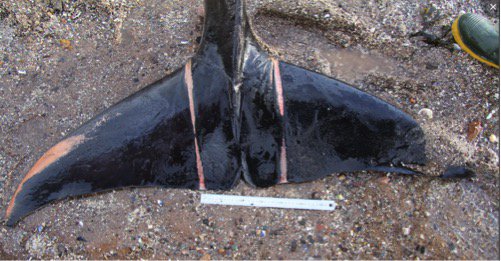
A harbour porpoise, victim of bycatch (c) CSIP/ZSL
The UK exports lobsters and crabs from pot fisheries to the US, which may result in a localised depletion of the minke whale population, with a shocking bycatch rate of 2.3 per cent.
The US National Oceanic and Atmospheric Administration (NOAA) has ruled that 46 nations can no longer export certain fish products to the US because fisheries in these countries catch marine mammals in violation of US law (the US Government issued partial comparability findings for 34 nations’ fisheries and denied comparability findings for all of 12 nations’ fisheries).
These nations have failed to adopt bycatch prevention measures comparable to those US fishers must follow under the Marine Mammal Protection Act (MMPA).
EIA Senior Ocean Campaigner Sarah Dolman said: “This is an important moment in history for marine mammal bycatch globally.”
Rarely is bycatch considered adequately in fisheries management measures and it is hoped the US action will change that by potentially preventing the US import of fish products from those nations the US has identified as not adequately protecting marine mammals from bycatch in their fisheries management.
 Dolman added: “This decision should be a wake-up call to many other nations who export fish products to the US too. For example, while the list included Ireland and Türkiye within Europe, bycatch in European waters is a huge problem in most countries with fisheries here, as recently highlighted in the EIA report Catch of the Day.
“Bycatch is the most significant threat to marine mammals around the world and it is a horrible way for individual whales, dolphins and seals to die. Globally, fisheries kill hundreds of thousands of marine mammals as bycatch, many threatening vulnerable populations, causing declines and exacerbating increasing pressures faced from climate change.
“The US MMPA Import Provisions provide the best opportunity for significant improvements in fisheries management globally.”
Each country exporting fish and fish products into the US has had to demonstrate they meet US bycatch standards in order to continue to export fish and fish products to the lucrative market.
They must do this by applying for and receiving a “comparability finding” for each of their fisheries. The comparability finding measures the effectiveness of the harvesting nation’s regulatory bycatch programme compared to the US system. The bans will take effect on 1 January 2026.
In the 2023 report Ban Bycatch, EIA and partners at the Natural Resources Defence Council, Animal Welfare Institute and Center for Biological Diversity surveyed 11 countries of various income levels and capacity from around the globe – Canada, Ecuador, Fiji, France, India, Indonesia, Mexico, Norway, South Africa, South Korea and the UK.
Our assessments of publicly available data from these countries revealed it was unlikely any of them could demonstrate that all their fisheries’ exports to the US are meeting US standards for marine mammal bycatch.
Common failures in these countries included poor assessment of the status of marine mammal populations, a lack of adequate bycatch monitoring, mitigation and regulations as well as poor enforcement.
Application of the MMPA presents a major opportunity to reduce marine mammal bycatch substantially worldwide. It also creates a challenge for many countries which do not have existing bycatch assessment and monitoring programmes or the resources to develop and sustain such programmes.
However, it has been almost 10 years since the US issued the Rule, which is time enough for every country to review fisheries and implement measures to reduce marine mammal bycatch and prevent US sanction.
The US is the world’s largest seafood importer, with more than $26.6 billion in fish products being imported from more than 140 nations in 2024. About 80 per cent of fish products consumed in the US are imported.
* Nations receiving comparability findings for a subset of their fisheries on the US List of Foreign Fisheries are Bangladesh, Brazil, Cameroon, Chile, China, Colombia, Ecuador, El Salvador, Ghana, Indonesia, Ireland, Kenya, Liberia, Madagascar, Malaysia, Mauritania, Mexico, Mozambique, Myanmar (Burma), Nigeria, Oman, Peru, Philippines, Republic of Korea, Saint Kitts and Nevis, Saudi Arabia, Senegal, Somalia, Sri Lanka, Suriname, Taiwan, Türkiye, United Arab Emirates and Vietnam. Nations that failed to obtain comparability findings for all export and exempt fisheries are The Gambia, Grenada, Guinea, Namibia, New Caledonia, Russia, Saint Lucia and Togo.