Behind the front: How company networks are keeping wildlife trafficking alive in Vietnam



Our latest Wildlife report, A Pivotal Player – Vietnam’s ongoing fight against the illegal wildlife trade, provides an updated look at elephant ivory, pangolin scale and rhino horn trafficking implicating Vietnam between 2022-24. In this special follow-up blog – based on the work of our Investigation & Intelligence team’s painstaking tracking of individuals and analysing data to build a comprehensive picture of how criminal organisations are set up, function and avoid detection – we take a closer look at how the illegal wildlife trade in Vietnam is conducted through an intertwined network of outwardly legitimate commercial businesses. Please note that some details have been redacted for security reasons.
When customs officers in Vietnam opened a container in March 2019, they discovered something unusual – declared as plastic pellets, the shipment was in fact full of pangolin scales.
Days later, two more shipments arrived, this time filled with rare sandalwood. The interesting part? They were all linked to the same circle of companies.
On the surface, these firms appeared to be ordinary import/export businesses. In reality, they formed part of a deliberately constructed web of companies set up to conceal the illegal wildlife trade, a pattern EIA investigations have continued to uncover time and again.
Commendable progress is being made in Vietnam, but more needs to be done.
At the centre of this network was an organiser called [REDACTED]. He was infamous for setting up companies then stepping aside. Once a firm became risky, he transferred ownership to a relative, an associate or even his brother.
One company, registered as [REDACTED], was linked to the pangolin seizure. Shortly after, the company changed its name to [REDACTED]. On paper, it looked brand new. In reality, it was business as usual.
The pattern repeated – create, rename and reshuffle. By the time authorities could have caught up, control had already shifted elsewhere in the network.

Large amounts of illegal ivory left Angola ivory seized in Vietnam (c) Vietnam Customs
Dig a little deeper and the connections multiply. Phone numbers tied to [REDACTED] appeared in company tax profiles, then resurfaced linked to social media accounts promoting another firm. Two companies, supposedly unrelated, shared not only a registered address but even the same mobile number.
Even company names carried hidden clues. One firm called [REDACTED] seemed to draw its title from a blend of one individual’s name and that of a close associate, suggesting their business ties were not just coincidental, but deliberate.
While some companies operated openly in logistics, others quietly controlled bonded warehouses — facilities meant to store goods in transit. These warehouses became staging points for wildlife shipments, with illegal goods hidden among frozen meat or other everyday items.
When seizures took place, one warehouse simply shut down while the network shifted activity to another. The trade barely skipped a beat.
Most of these firms were registered in strategic locations — Hanoi, Hai Phong and Mong Cai. These are not just business hubs they’re also hotspots for the illegal wildlife trade and international shipping as well as border crossings.
By positioning themselves close to ports, the networks reduced the risks of detection and maximised their control of shipments.
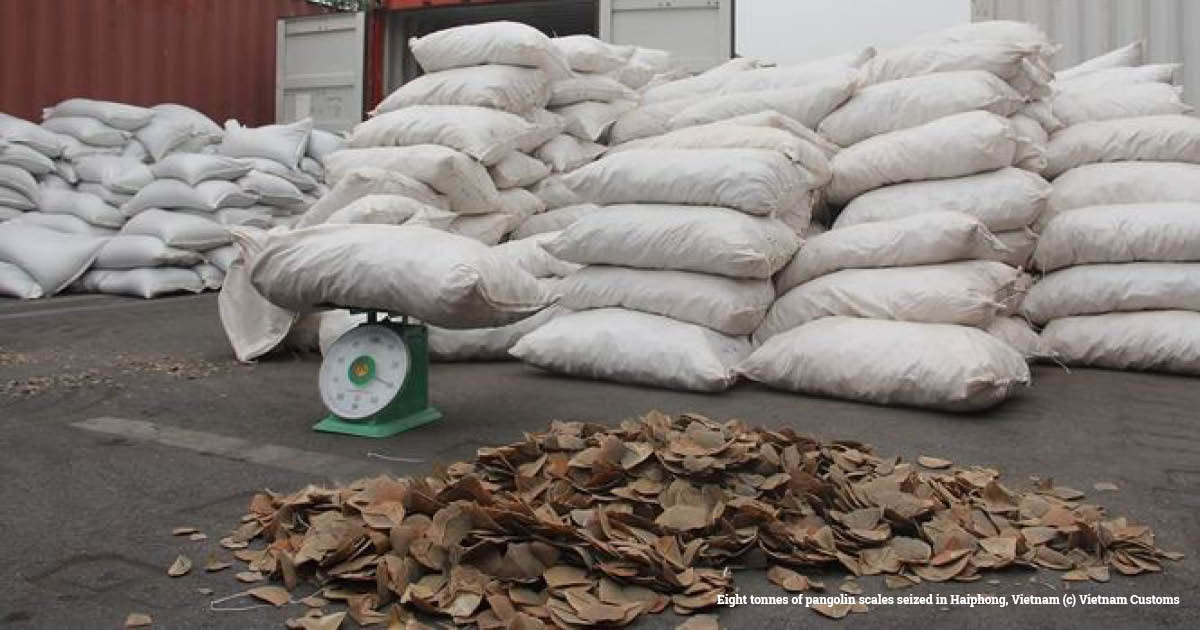
Pangolin scales seized in Vietnam, 2019
What makes these networks striking is how resilient they are. Despite multiple seizures, the companies kept operating. Some even expanded into new areas of trade. Changing names, switching directors and co-mingling legal with illegal business allowed them to avoid real disruption.
The result is a corporate shell game — just as one company is exposed, another is ready to step in.
The story of these companies isn’t just about Vietnam. It’s a window into how wildlife trafficking operates globally. Sophisticated networks rely on company structures, not just smuggling routes, to stay ahead of the law.
Every overlapping phone number, recycled address or sudden name change is more than coincidence, it’s a sign of how tightly woven these networks are.
To dismantle them, enforcement can’t just stop at the container door. It must follow the paper trails, trace the connections, follow the money and expose the hidden machinery keeping wildlife crime alive under the cover of legitimate business.