A decade after the Kigali Amendment, we need renewed ambition for ozone and climate

As the Kigali Amendment marks its 10th anniversary, EIA campaigners will join governments and civil society organisations in Kigali, Rwanda next week ( 2-6 November) for the 38th Meeting of the Parties (MOP38) to the Montreal Protocol, calling for stronger action to protect the ozone layer and tackle climate change.
EIA was instrumental in initiating discussions around controlling climate-harming hydrofluorocarbon (HFC) gases under the Montreal Protocol in 2008, subsequently attending every single negotiation meeting which led to the adoption of the Kigali Amendment in 2016.
The Amendment commits countries to phasing down HFCs, powerful greenhouse gases widely used in refrigeration and air-conditioning. Its implementation is expected to avoid up to 0.5°C of global warming by the end of the century.
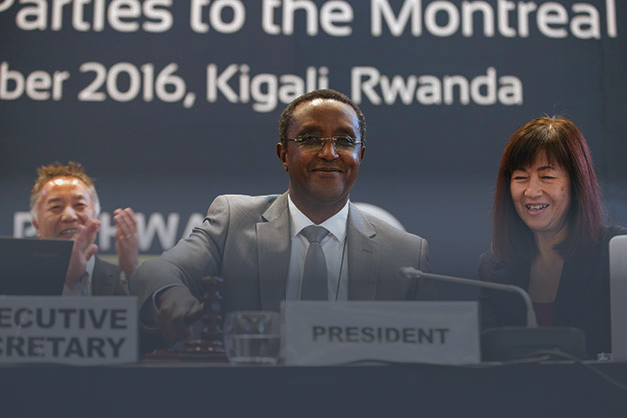
Agreeing the Kigali Amendment in 2016 (c) IISD
A decade on, progress has been made, but significant challenges remain. Illegal trade, harmful industrial emissions, gaps in atmospheric monitoring and growing contamination of the environment with the persistent breakdown of products from HFC replacements threaten to undermine the achievements of one of the world’s most successful environmental agreements.
With the effects of climate change intensifying around the world, EIA is calling on governments to build on the success of the Montreal Protocol by accelerating the HFC phase-down, strengthening enforcement and monitoring as well as addressing emerging threats to the ozone layer, climate and public health.
Key issues EIA will be raising at MOP38 include:
You can read our new briefing to MOP38 on our website now.
EIA campaigners attending MOP38 will be available for interviews and comment throughout the meeting on the negotiations, the future of the Kigali Amendment and the challenges facing international efforts to protect the ozone layer and climate.