Green fuel compromised by dirty trade – a look at Indonesia’s palm oil export scandal



The Attorney General’s Office in Indonesia has named 11 individuals and 12 associated companies as suspects in fraudulent exports of crude palm oil (CPO).
Investigators allege that between 2022-24, shipments of CPO were deliberately mis-declared as palm oil mill effluent (POME) – the liquid waste from palm oil mills – or other derivatives, obscuring their true nature in international trade.
Due to POME being a waste product, it is used as a renewable source across several products, including biofuels, fertiliser and animal products.
During this period, Indonesia exported POME products globally, as shown in the figure below. The largest markets are China, Europe (particularly Italy, the Netherlands and Spain) and Malaysia.
Yet even before the Attorney General’s announcement on 10 February this year, concerns had been raised as to whether global consumption of POME had outpaced what could realistically be produced by palm oil mills. The discrepancy points to a critical concern – were buyers receiving what the documentation claimed or had fraudulent labelling gone largely unchecked?
These concerns echo findings published in EIA’s 2025 briefing The Palm Oil Black Box, highlighting an alarming increase in the trade in palm oil residue and waste products to be used for biofuels and the use of different trade codes – known as harmonised system (HS) codes – to seemingly avoid regulations, duties and taxes, leading to potentially fraudulent behaviour.
The investigation now unfolding in Indonesia appears to confirm those warnings, suggesting that misclassification may not be incidental but systemic.
This is especially pertinent for shipments destined for use as biofuels in the EU, estimated to comprise 29 per cent of Indonesia’s export trade between 2022-24 (see figure above).
The EU’s Renewable Energy Directive (RED) which aims to help tackle climate change and sets targets for renewable energy use, including in the transport sector, has increased demand for biofuels to meet the targets. The EU-recognised certification scheme for biofuels – the International Sustainability Carbon Certification (ISCC) – is meant to ensure traceability and no mislabelling, but the scheme has already come under intense scrutiny for fraud and is not delivering what it promises.
If the products being used to make biofuels are actually palm oil that causes deforestation, this undermines the whole idea behind biofuels being a green fuel that helps prevent climate change.
Forests are critical for climate change because they absorb and store large amounts of carbon, while deforestation releases that carbon back into the atmosphere, accelerating global warming.

Forest cleared for oil palm plantation in Indonesia (c) EIA
During the Attorney General’s investigation, irregularities were discovered in the classification of export commodities, with CPO, which has a higher acid content, seemingly being claimed as Palm Oil Mill Effluent or Palm Acid Oil using the HS (Harmonised System) code 2306.
The Attorney General suspects the suspects actively played a role in developing, using and allowing these mechanisms to continue.
The information released included abbreviations for the individuals and companies. Of the 11 suspects involved in the case, three are public servant and are alleged to be involved in “kickbacks/rewards to smooth the administrative and export supervision process, so that inappropriate classifications can continue to be used without correction”, while the remainder are individuals who are directors/commissioners in companies.
| Individual abbreviation | Position | Company acronym/Government department |
| ES | Director | PT SMP |
| ES | Director | PT SMS |
| ES | Director | PT SMA |
| ERW | Director | PT BMM |
| FLX | President Director | PT AP |
| RND | Director | PT TAJ |
| TNY | Director | PT TEO |
| TNY | Director and Shareholder | PT Green Product International |
| VNR | Director | PT SIP |
| RBN | Director | PT CKK |
| YSR | President Director | PT SBP |
| YSR | Commissioner | PT MAS |
| LHB | Head of Sub-Directorate | Ministry of Industry, Indonesia |
| FJR | Technical director of customs | Directorate General of Customs and Excise, Indonesia |
| MZ | Civil servant | Pekanbaru Customs and Excise Service Office (KPBC). |
This investigation is a clear example of what many feared – that CPO is being illegally sold as a waste product, casting doubts on the integrity of current supply chains.
As regions expand the use of biofuels to meet climate targets, and due to global fuel instability, these issues are likely to persist without robust systems to track supply chains and verify products and will cause further deforestation and social injustices.
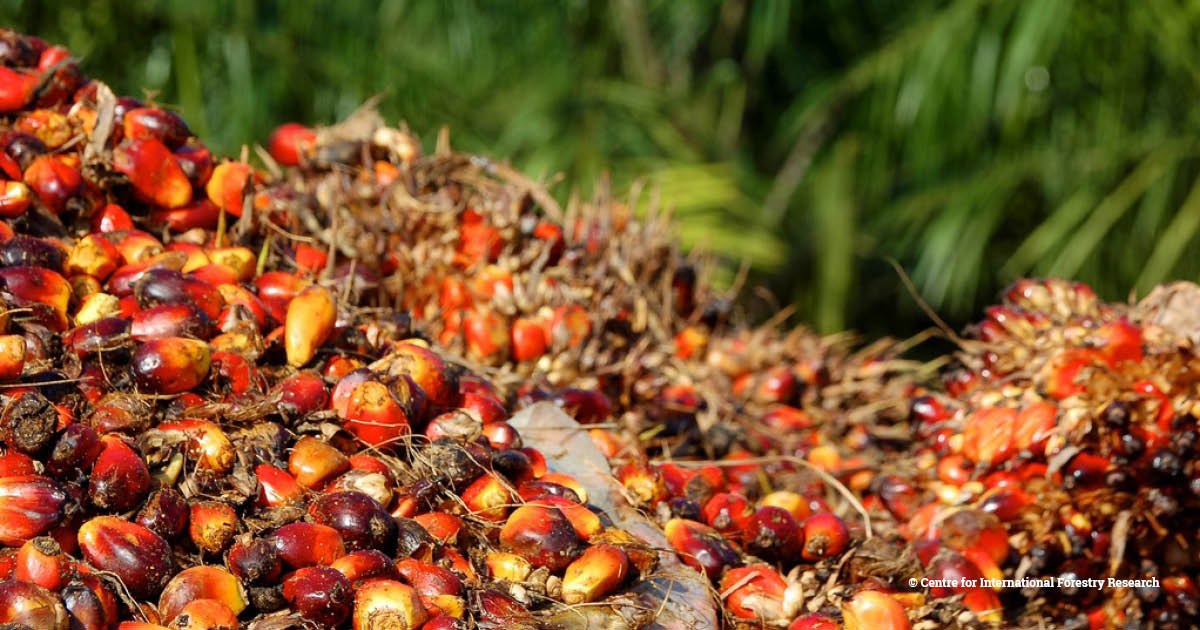
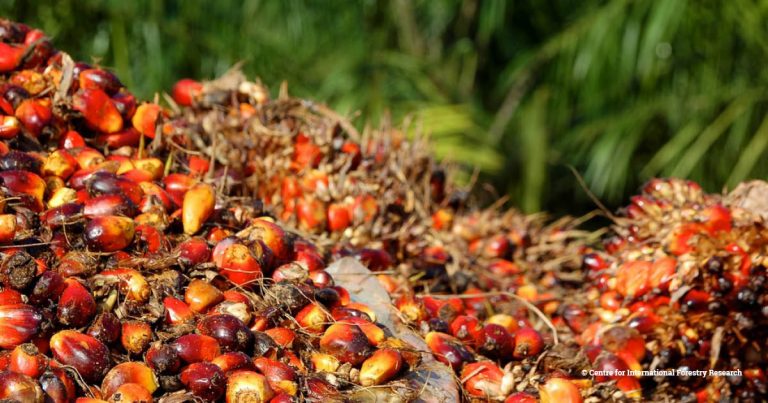
Palm oil fruits after harvest
A key loophole in current EU regulations is that most residue and waste palm oil products are not subject to any sustainability criteria under the EU RED, nor under the EU Deforestation Regulation (EUDR) – an EU law due to come into effect at the end of 2026 to ensure palm oil and other commodities are not causing deforestation and are not illegal.
This loophole in part seems to be driving fraudulent behaviour, with palm oil being reclassified as other products such as POME to avoid such criteria.
To ensure these loopholes are closed, or the EU to commit to regular, transparent evidence-based reviews of EUDR product coverage. The EU is currently considering the scope of palm oil trade (HS) codes regulated under the EUDR. While the bloc has proposed the inclusion of additional trade codes for palm oil, others remain omitted, giving an inconsistent approach and risking products being fraudulently reclassified to bypass the rules. Greater consistency and inclusion of products is needed.
Meanwhile, the EU has already been considering whether to continue to rely on its certification scheme for biofuels – the ISCC. The only company so far named in full by the Attorney General’s Office as a suspect is PT Green Product International. Between 2022-24 it was ISCC-certified and exported POME and palm acid oil, including to companies headquartered in the EU.
If the investigation in Indonesia does find that the individuals and their associated companies did commit fraudulent behaviour, this will warrant further investigation in the EU itself and of the ISCC.