Time to leapfrog over the chemical industry’s next generation of climate-wrecking refrigerants



EIA Climate campaigners are in Bangkok this week for a major international meeting and today (10 July) released a new report urging immediate action to halt the transition to yet another generation of harmful fluorinated gases.
 Persistent Problems – The hidden impacts of hydrofluoroolefins, the latest generation of fluorinated gases makes the case to end the cycle of replacing one class of damaging fluorinated gases (F-gases) with another.
For many decades, F-gases have been used as refrigerants as well as in other applications such as the production of insulation foams.
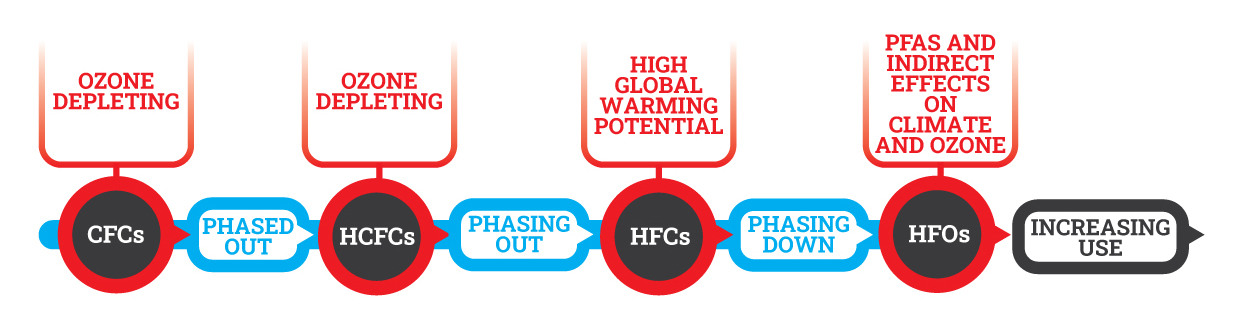
Under the Montreal Protocol, successive generations of F-gases have been phased out, or are being restricted globally, due to their devastating environmental impacts, with each generation contributing to ozone layer depletion, climate change and/or chemical pollution to varying degrees.
Now, as countries around the world are phasing down the use of climate-wrecking hydrofluorocarbons (HFCs), the fluorochemical industry is promoting hydrofluoroolefins (HFOs) as a new generation of F-gases which, it claims, are not only sustainable but essential.
However, as Persistent Problems details, such claims overlook the environmental, trade and governance issues associated with HFOs and the widespread availability of non-fluorinated alternatives, including natural refrigerants.
As parties to the Montreal Protocol gather in Bangkok for the 47th meeting of the Open-Ended Working Group (OEWG47), they should reflect on the progress of the Protocol and the threats to its goals and principles posed by the ‘next generation’ of (F-gases).
Generations of damaging F-gases
The argument for HFO sustainability often hinges on the fact that their direct contribution to climate change and ozone depletion is small – they have low global warming potential (GWP) and ozone-depleting potential (ODP) values.
But HFOs do contribute indirectly to both climate change and ozone depletion. The production of HFOs and their breakdown in the atmosphere leads to emissions of high GWP and ODP gases.
EIA Climate Campaigner Joanna Sparks said: “The illusion of HFO’s sustainability is shattered by the emissions of climate- and ozone-damaging gases associated with their production and use.
“Add to this the fact that HFOs are a source of persistent and pervasive per- and polyfluoroalkyl substances (PFAS, aka ‘forever chemicals’) pollution, meaning their use is irreversibly contaminating the environment and contributing to yet another planetary crisis, and it is clear that, regardless of what the fluorochemical industry claims, HFOs pose unnecessary risks to people and to our environment.”
Contamination of the environment with PFAS is a global concern. Many HFOs are a source of trifluoroacetic acid (TFA), a short chain PFAS which is the subject of increasing attention thanks to its widespread presence in the environment.
TFA has been found in drinking water, food sources and human bodies and levels are rapidly increasing due to human activity.
Like other PFAS, TFA is a persistent substance which does not degrade, instead remaining in the environment for an extremely long time. TFA and the risks it poses to public health and the environment are the subject of intense debate in the scientific community and beyond.
However, many scientists, civil society organisations and other experts firmly believe, as EIA does, that we should avoid irreversibly contaminating our environment with persistent chemical pollutants of any kind, including TFA.

Environmental impacts during the lifecycle of HFOs
HFOs pose unnecessary risks to people and the environment and, while there are questions still to be answered on the extent of those risks, this must not be used as a reason to delay action.
Non-fluorinated alternatives are already available for most F-gas applications, so there is no need to repeat history by transitioning to yet another generation of harmful fluorochemicals.
The production, use and emission of HFOs is already increasing around the world and delay will only make its consequences harder to overcome.
EIA Climate Policy Analyst Christopher Douglass said: “Time and time again, the fluorochemical industry has produced expensive, patented refrigerants, controlling the supply and with little transparency into their production and its impacts.
“The industry may be eager to flaunt its newest patented refrigerants, but the rest of us are tired of the bait-and-switch, being left to clean up the harms and costs of these chemicals only after they are ubiquitous in our lives.
“The risks are clear and so is the solution – invest in non-fluorinated refrigerants, which are affordable and already widely in use in many applications.”
EIA reminds parties at OEWG47 that the precautionary principle is a cornerstone of the Protocol and the transition to HFOs is at odds with its tenets.
Parties should take action to end the use of all F-gases – including HFOs – and to tackle emissions associated with production processes and accelerate the transition to non-fluorinated alternatives and not in-kind solutions.