The Kigali Amendment’s 10th anniversary – and a call for renewed ambition

As governments gather for the 38th Meeting of the Parties (MOP38) to the Montreal Protocol, EIA and 11 civil society partner organisations have released a joint statement reflecting on the first decade of the Kigali Amendment and outlining priorities for the years ahead.
Adopted in 2016, the Amendment commits countries to phase down hydrofluorocarbons (HFCs), powerful greenhouse gases widely used in cooling and refrigeration.
Its successful implementation is expected to avoid up to 0.5°C of global warming by the end of the century, making it one of the most significant climate agreements ever negotiated.
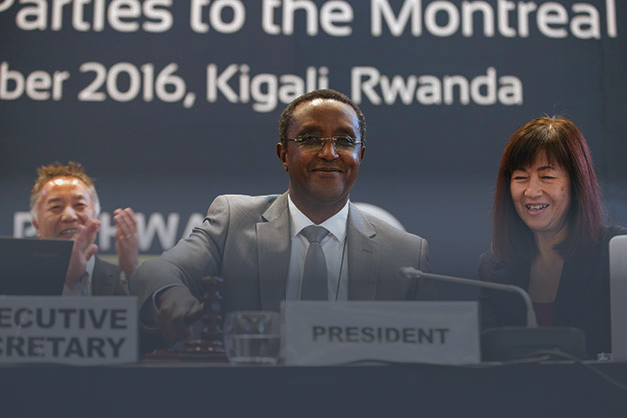
Agreeing the Kigali Amendment in 2016 (c) IISD
Our joint statement celebrates the progress achieved under the Amendment but warns that, as we exceed the 1.5°C global warming threshold, every fraction of a degree of warming matters.
The briefing highlights our priorities for strengthening Kigali implementation, including improving licensing systems, combating illegal trade in refrigerants and cooling equipment, strengthening controls on HFC-23 emissions and accelerating the transition to energy-efficient cooling technologies. It also calls for countries to explore opportunities to secure additional climate benefits through faster HFC reductions.
Looking beyond the HFC phase-down, we are urging action on a range of emerging challenges, including lifecycle refrigerant management, emissions from fluorochemical production, rising nitrous oxide emissions, very short-lived substances and persistent per- and polyfluoroalkyl substances (PFAS) pollution associated with fluorinated refrigerants.
As the Montreal Protocol approaches its 40th anniversary, we and our partner NGOs contend that its continued success will depend on its ability to evolve and strengthen.