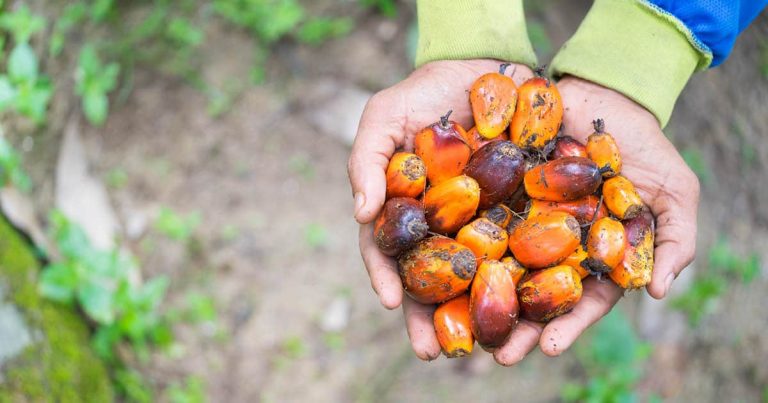
New investigation raises questions over corporate links to palm oil deforestation

A new investigation by EIA and our Indonesian partner Kaoem Telepak (KT) has uncovered evidence raising serious questions about whether corporate separation is allowing major palm oil businesses to distance themselves from companies associated with extensive deforestation in Indonesia.
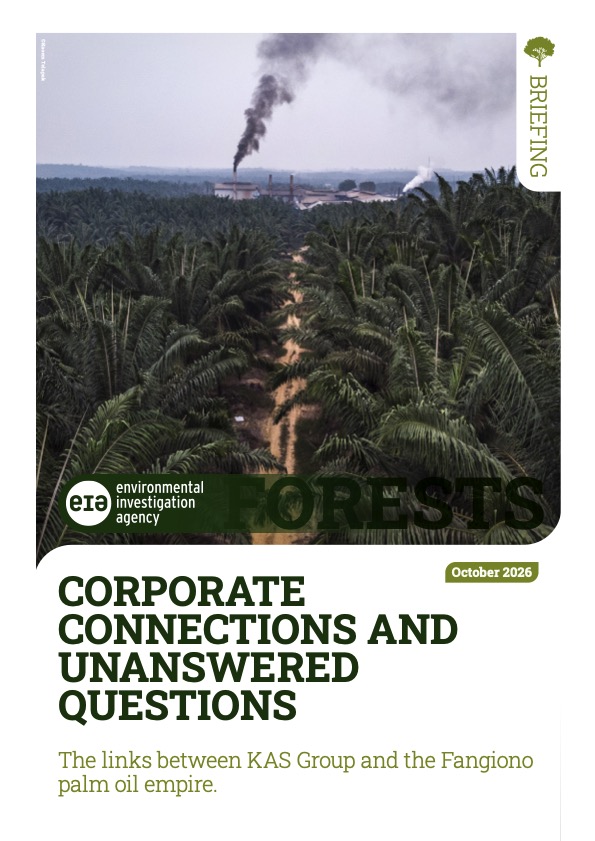
The investigation, Corporate Connections and Unanswered Questions – The links between KAS Group and the Fangiono palm oil empire, examines the highly opaque KAS Group, previously known as New Borneo Agri (NBA) or the Sulaidy Group.
Companies associated with the group have repeatedly ranked among Indonesia’s largest palm oil deforesters.
 The central concern is simple – while KAS is presented as a separate corporate group, EIA and KT have identified a pattern of apparent operational, commercial and personnel connections from KAS to First Resources and FAP Agri, two major palm oil businesses controlled by members of Indonesia’s Fangiono family.
This matters because corporate separation can potentially place environmentally damaging operations outside the sustainability commitments, scrutiny and accountability applied to a larger corporate group. If companies are genuinely independent, they should operate as such. The evidence raises questions about whether that is the case.
A complaint to the Roundtable on Sustainable Palm Oil (RSPO) was made in 2021 alleging First Resources controlled these other groups, to which NBA was added in 2024. This complaint was ultimately closed in 2025, with First Resources’ RSPO membership suspended for three months for failing to fully declare its relationship with FAP Agri. The outcome left unresolved allegations and provoked dismay, exposing weaknesses in the RSPO’s approach to investigating complex ownership and control structures.
Among the findings, EIA and KT identified recent instances in which KAS group companies are described as part of First Resources. We also found indications that the KAS group was involved in First Resources palm oil concessions (PT PMP and PT PPM) which were acquired and subsequently sold in South Sorong. These concessions are now owned by a company (PT HAM) which has the same ultimate beneficial owner – a British Virgin Islands company (Zarvex Global Ltd) – as a shipping company (PT BMS) associated with First Resources.
Also identified were apparent personnel and commercial overlaps involving KAS and FAP Agri, including evidence indicating that a Commissioner of KAS companies is also FAP Agri’s Commercial Head and documents recording transactions between companies in the two groups.
KAS itself has an extraordinarily limited public corporate presence despite reportedly controlling about 70,000 hectares of land, operating six palm oil mills and employing about 15,000 people. Its corporate structure ultimately leads to entities registered in the British Virgin Islands whose beneficial owners are not publicly disclosed.
EIA Forests Campaigner Ben Melling said: “This is about accountability. A company cannot simply be judged by the environmental record of the businesses which formally carry its name if, behind the corporate structure, there are significant links to other companies which are clearing forests.
“We are not alleging that corporate separation is in itself illegal. We are saying that the evidence raises serious questions about whether these companies are as independent as they have been presented – and whether corporate structures are allowing deforestation to fall through an accountability gap.”
First Resources has previously rejected allegations that KAS/NBA is a “shadow company” and told EIA that KAS is not a subsidiary, associated company, related party or interested person of First Resources. It also said it has neither purchased palm oil products from, nor entered into other transactions with, KAS.
FAP Agri has disputed our interpretation of evidence concerning transactions and personnel links and said that commercial relationships do not demonstrate corporate control.
Our findings are being released alongside a separate investigation by Rainforest Action Network (RAN), highlighting that palm oil from companies responsible for thousands of hectares of recent rainforest destruction is transported, stored and shipped through shared infrastructure where it appears to be commingled before entering international markets as purportedly compliant with No Deforestation, No Peatland, No Exploitation (NDPE) commitments.
EIA and KT are calling on First Resources and FAP Agri to provide full public disclosure of their historical and current relationships with KAS, including transactions, management and staffing links, procurement, logistics and financing arrangements as the evidence raises significant concerns that First Resources and FAP Agri may not be publicly disclosing the true nature of their relationship with the Group – creating a serious risk of misleading investors and buyers.
Melling added: “Until these questions are satisfactorily answered, we are also calling on buyers and other stakeholders to suspend identified sourcing, trading and other relationships with the KAS Group.”