Failure of political will makes crimes affecting the environment a worsening threat


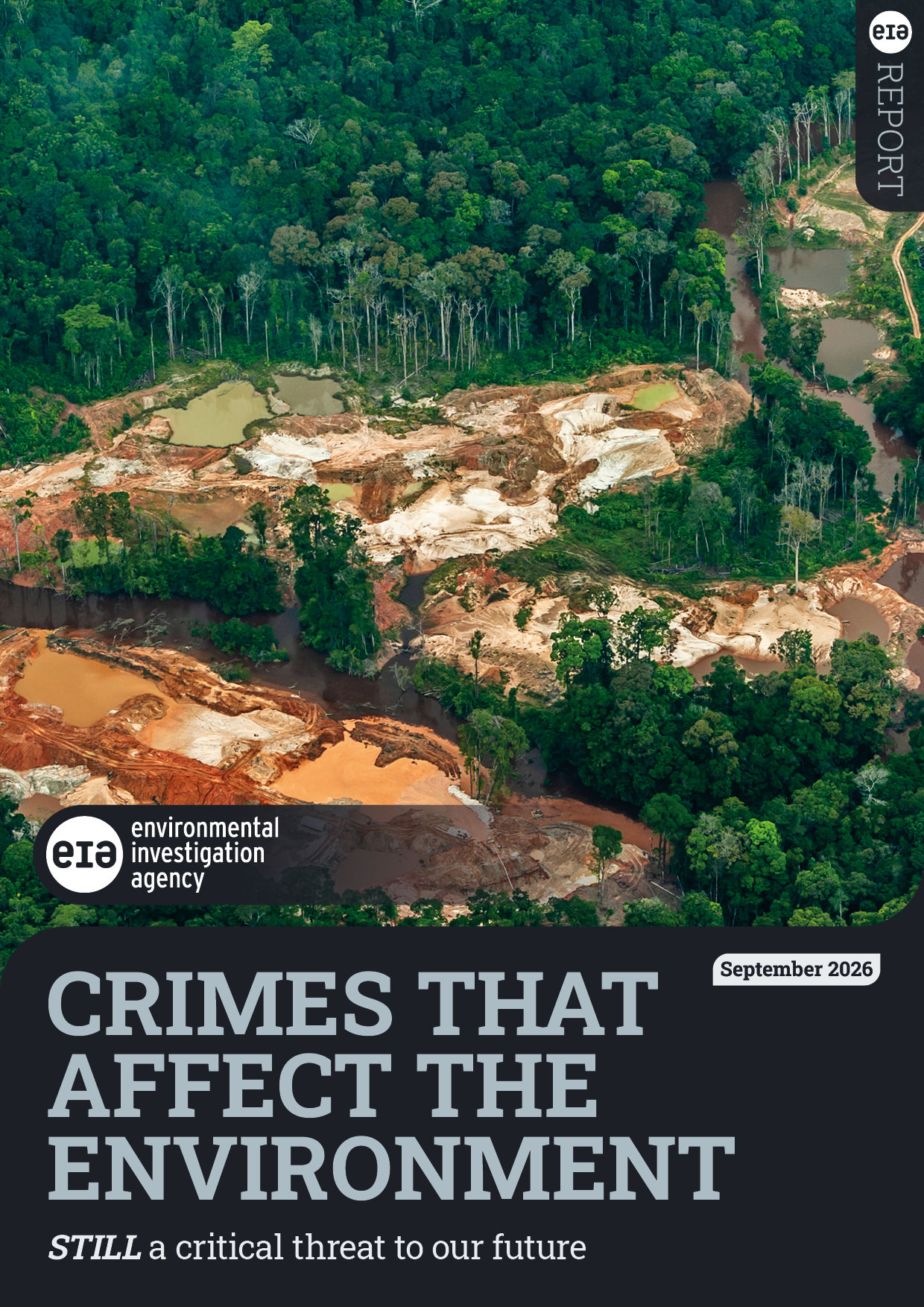
In our landmark 2008 report Environmental Crime – A Threat to Our Future, EIA was the first to analyse the combined impact of multiple environmental crime types and the coordinated global response they demanded.
Some 18 years later, that call for urgent action has gone substantially unheeded.
In our new report Crimes that Affect the Environment – STILL a critical threat to our future, we conclude that crime and abuse has actually grown more sophisticated, more lucrative and even more damaging to the planet and human society.
 EIA Securing Criminal Justice Programme Lead Justin Gosling said: “As an organisation that has spent more than four decades investigating and combating environmental crime and abuse across all three pillars of the triple planetary crisis – climate change, pollution and biodiversity loss – EIA is uniquely positioned to speak to both the scale of the threat and the response required to address it.
“Many of the structural weaknesses identified in 2008 — fragmented legislation, weak deterrence, limited cross-border cooperation and insufficient political will — persist today, even as the consequences of inaction have become progressively harder and, in some cases, impossible to reverse.”
Crimes that Affect the Environment – STILL a critical threat to our future captures the breadth of not only environmental crime types but also associated crimes such as money laundering and corruption. We argue they must be treated not as isolated regulatory failures, but as interconnected expressions of transnational organised crime driving the triple planetary crisis.
Key crime types covered in the report include:
Gosling added: “Across all of these crime types, common threads emerge – profit incentives that dwarf enforcement risks, corruption as a structural enabler, opaque supply chains allowing illegal commodities to enter legitimate markets and a systematic failure to treat environmental crime with the seriousness it warrants under existing frameworks, including the UN Convention against Transnational Organised Crime (UNTOC).
“This is not a failure of available tools — the legal frameworks and cooperation mechanisms needed to act already exist. The failure has been one of political will, resourcing and coordination.”
The report’s recommendations to address the mounting problem of environmental crime include operationalising UNTOC more effectively, strengthening cross-border enforcement and building the political commitment to treat environmental crime as the global security threat it has always been.