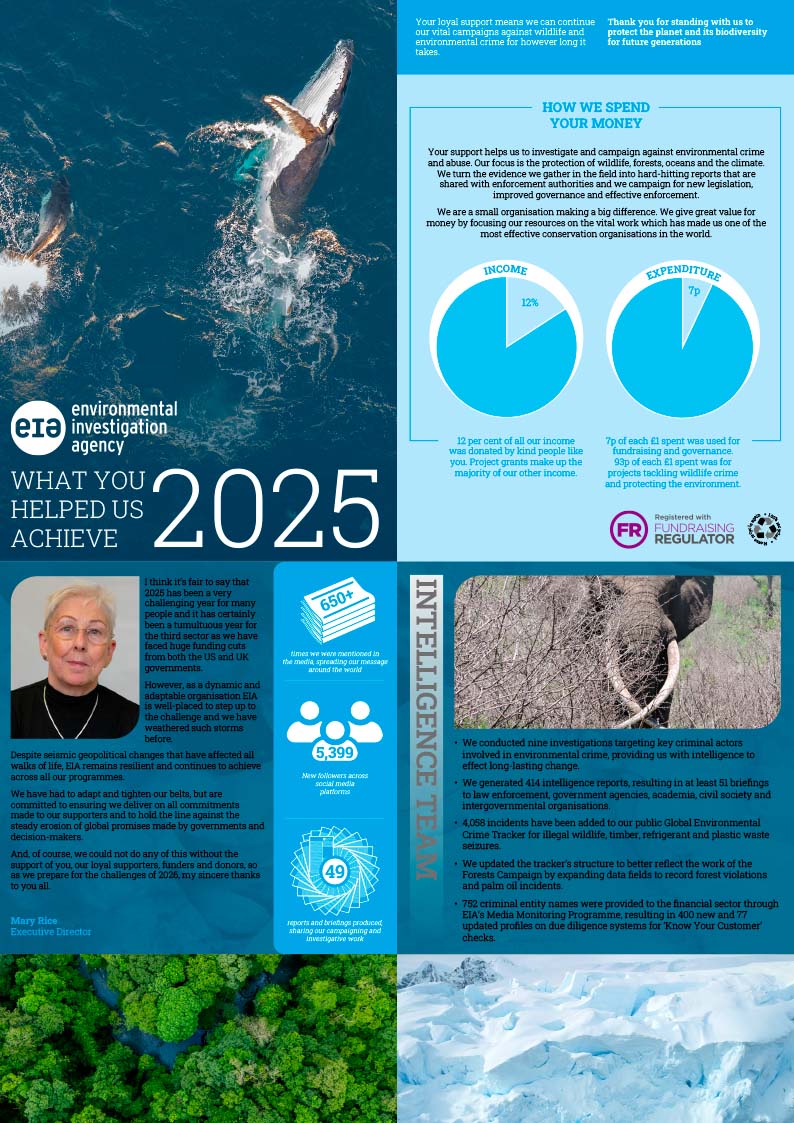
Year in Review – 2025
The EIA's Year in Review 2025, keeping you up to date on last year’s successes.

The EIA's Year in Review 2025, keeping you up to date on last year’s successes.
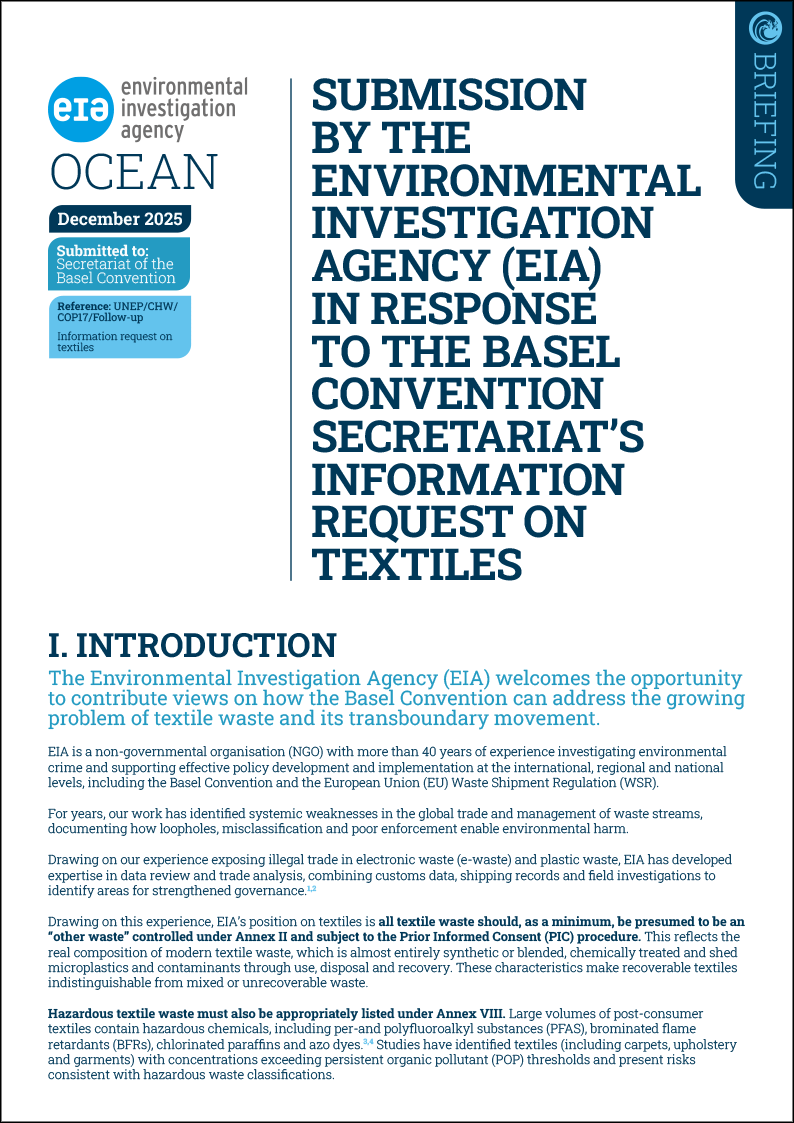
Submission by the Environmental Investigation Agency (EIA) in response to the Basel convention secretariat’s information request on textiles EIA is a non-governmental organisation (NGO) with more than 40 years of experience investigating environmental crime and supporting effective policy development and implementation at the international, regional and national levels, including the Basel Convention and the European […]

The 97th Meeting of the Executive Committee of the Multilateral Fund (ExCom97) presents a critical opportunity to demonstrate the effectiveness of collaborative multilateralism and advance cost-effective climate and ozone mitigation at a time when global action is more urgent than ever.
Explore urgent strategies to deliver a strong global plastics treaty and end plastic pollution after stalled UN negotiations.

EIA comments on the CITES secretariat’s recommendation to delete decision 14.69

The illegal trade of pangolins in China All eight recognised species of pangolin face high risks of extinction, with the primary threats to their survival being poaching and trade of their meat, body parts and scales. In order to address declining pangolin populations, increasingly stringent measures for protection of the species have been adopted both through the Convention on International Trade in Endangered Species of Wild Fauna and Flora (CITES) and at national levels.