Whaling meeting concludes with no progress on a South Atlantic whale sanctuary
The 70th International Whaling Commission (IWC70) meeting concluded today (2 October) in Hobart, Australia with progress in many areas but disappointment for efforts to establish a South Atlantic whale sanctuary.
A number of governance issues, decisions and resolutions were negotiated during the week. Resolutions on “the Global Trade in Fish Maw and Incidental Catches of Threatened Cetaceans”, “Vessel Strikes” proposed by the EU and “Cetacean Strandings as a Cross-Cutting Priority of the IWC”, proposed jointly by the EU and UK, were widely supported and adopted.
The Hobart Declaration, which describes the IWC in the context of the 80th anniversary of the signing of the whaling convention, was adopted by consensus. A resolution on “Small Cetacean Directed Takes Linked to Commercial Fisheries”, brought forward by Switzerland, was regrettably withdrawn from the floor during negotiations.
Despite the clear majority of IWC contracting governments being in favour of whale protection, once again the South Atlantic whale sanctuary proposed by Brazil, Argentina and Uruguay fell short of the 75 per cent majority required for amendments to the Schedule.
The proposal received 39 votes in favour, with 18 (Antigua & Barbuda, Benin, Cambodia, Cóte d’Ivoire, Grenada, Laos, Marshall Islands, Mauritania, Morocco, Nauru, Nicaragua, Norway, Republic of Palau, Senegal, St Kitts and Nevis, St Lucia, Suriname and Tuvalu) against. Iceland and new member Türkiye abstained from the vote. At IWC69 in Peru in 2024, the proposal was lost by just a single vote.
The resolution for “the Implementation of a Conservation and Management Program for Whale Stocks aimed towards the Sustainable Use of Whale Resources”, which had been tabled by Antigua & Barbuda for the third IWC meeting in a row, was withdrawn on the last day of the meeting. Despite this, Antigua & Barbuda continued to attempt to set in motion a process via the Scientific Committee to re-examine the moratorium on commercial whaling, which was firmly rejected by New Zealand, the UK and Mexico.
EIA Senior Ocean Adviser Clare Perry said: “The world is a very different place from when the IWC was first established 80 years ago. Whales and other cetaceans are facing countless threats from the interconnected global emergencies of climate change, biodiversity loss and pollution.
“The moratorium on commercial whaling and the IWC’s conservation work are needed more than ever before but both are under threat.”
The volume of work being carried out by the IWC’s Scientific and Conservation Committee continues to increase, reflecting the challenges faced by the world’s cetaceans.
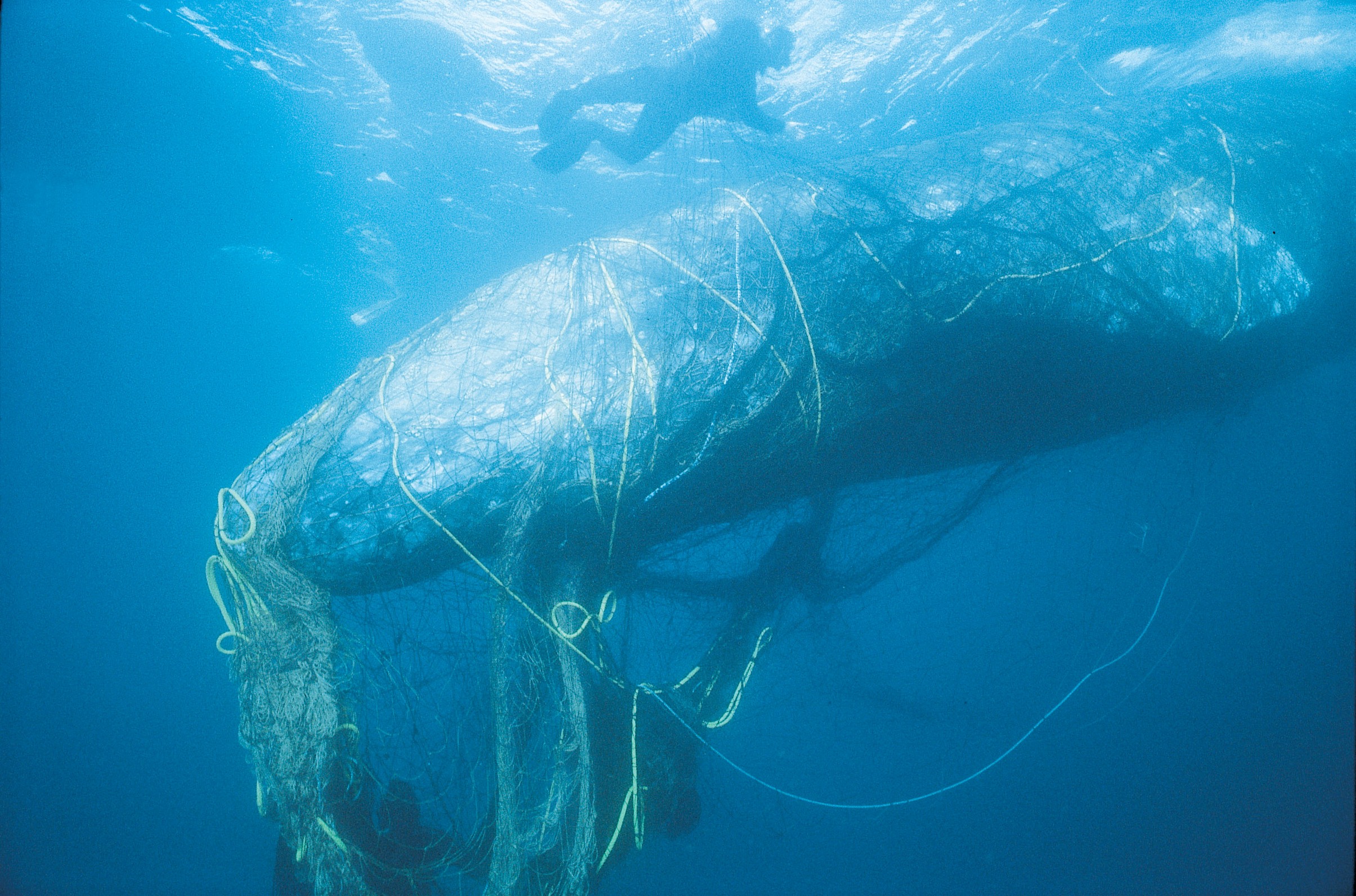
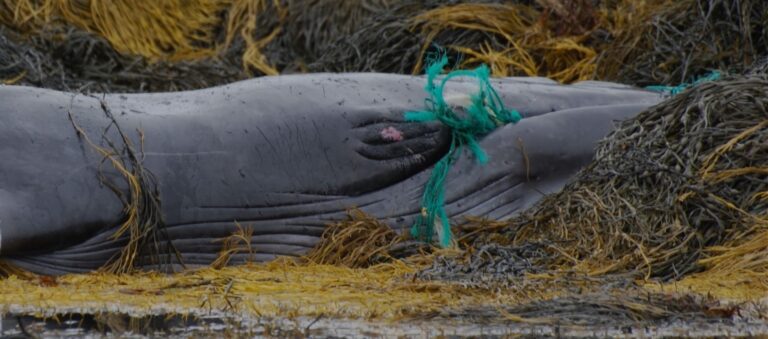
Gray whale entangled in netting (c) BobTalbot, via Monofilament Recovery & Recycling Program
Highlights discussed at the meeting included new bycatch mitigation pilot projects in Congo and Sri Lanka, as well as the agreement to draft a Conservation Management Plan (CMP) for Irrawaddy dolphins and a joint IWC/Conservation of Migratory Species (CMS) CMP for the Endangered sub-population of Arabian Sea humpback whales.
EIA Senior Ocean Campaigner Sarah Dolman said: “Once again the Scientific and Conservation Committee Chairs presented an impressive and diverse programme of work that is being delivered to protect global cetacean populations.
“However, the agreed budget increase, at three per cent and so below inflation, is a concern at a time when the Secretariat’s core work and the Scientific Committee’s work needs to expand.
“Governments need to place a higher priority on the work of the IWC, encourage other pro-conservation governments to join and build the capacity of the IWC to do its vital work.”