

DONATE

Reports

Briefing to the Informal Meeting on Facilitating Implementation of the Montreal Protocol

Following revelations of unexpected CFC-11 emissions in 2018 and reports of record atmospheric HFC-23 concentrations and other unexpected emissions, legitimate questions have been raised as to whether the Montreal Protocol’s institutions and controls are fit for purpose, not only to sustain the phase-out of ozone depleting substances (ODS) but also to address the unique challenges of the hydrofluorocarbons (HFC) phase-down.

Persistent Problems

EIA urges all governments and parties to the Montreal Protocol to apply the precautionary principle, wherever possible avoiding the uptake of HFOs to avoid unnecessary risks to people and the planet. Governments, parties to the Montreal Protocol and manufacturers and commercial users of these products must act to implement a transition away from all F-gases.

EU F-Gas Regulation Handbook 2024

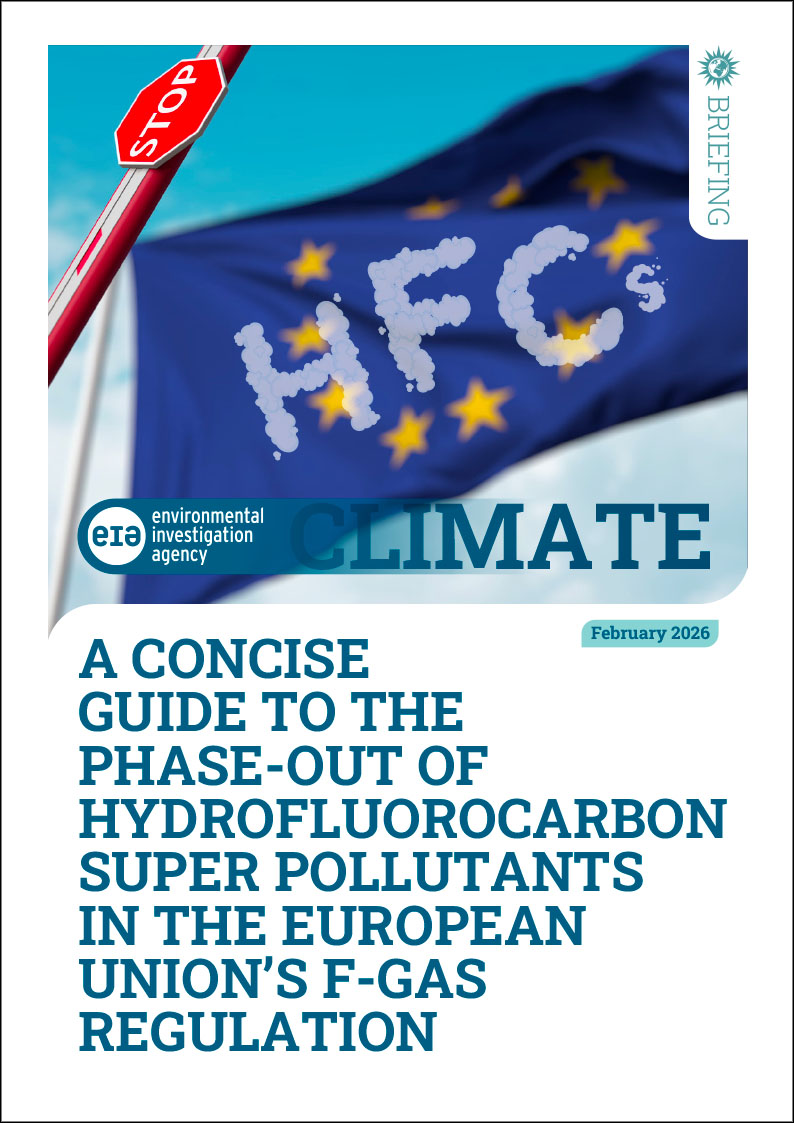
The European Union’s revised F-gas Regulation will support decarbonisation goals and drive innovation and green investment across a wide range of sectors, including heat pumps, the cold chain, healthcare and more.

Unchecked

Cumulative HFC-23 emissions since the adoption of the Kigali Amendment in 2016 are almost 106,000 tonnes, equivalent to 1.56 billion tonnes of CO2. A strong response from the Parties to the Montreal Protocol is required.